
Tag: ponzi scheme

  • QZ Asset Management Executes Full Exit Scam; Website Unreachable

    QZ Asset Management Executes Full Exit Scam; Website Unreachable

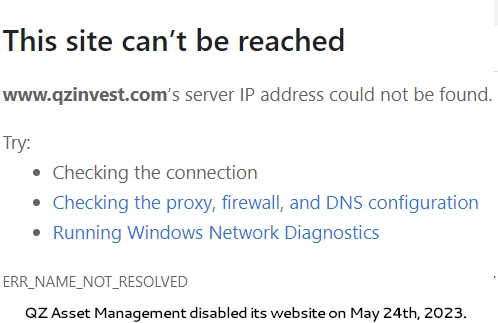
    The QZ Asset Management website has recently been taken offline, signaling the downfall of the notorious “SEC audit” exit scam perpetrated by this Ponzi scheme. Additionally, the social media accounts associated with QZ Asset Management have been removed from public view.
    QZ Asset Management emerged onto the scene in late 2022, enticing investors with promises of a remarkable 400% return on investment through its MLM crypto Ponzi scheme. The primary target market for QZ Asset Management and its promoters appeared to be investors in Africa, while the alleged masterminds behind the operation were believed to be Chinese scammers operating out of Hong Kong

    The scheme’s exit hoax gained momentum with the fraudulent announcement of a NASDAQ listing in late March, misleading investors further. Subsequently, on May 1st, QZ Asset Management abruptly halted withdrawals, intensifying concerns about the legitimacy of the operation.

    CEO Blake Yeung Pu Lei attempted to placate investors by attributing the disruption to an upcoming SEC audit, a claim that held no merit since the SEC does not conduct audits of private corporations outside of regulatory enforcement proceedings.

    Amidst the dissemination of misinformation regarding the false NASDAQ listing by prominent promoters, QZ Asset Management has been strategically distancing itself from its victims in Africa over the past few weeks.

    Now, all of these deceptive tactics have come to a screeching halt. QZ Asset Management has taken down its website and removed its previously accessible YouTube and Facebook accounts. While the Twitter profile for QZ Asset Management remains active, the account vanished back in February.

    Considering the distribution of cryptocurrency to offshore criminals and the unlikelihood of regulatory action from China, it seems improbable that QZ Asset Management will face consequences in that jurisdiction. Furthermore, African authorities may find themselves powerless to take any significant action in this matter.

    The precise number of victims affected by QZ Asset Management and the extent of their financial losses remain uncertain at present, pending unlikely updates in the future.


  • Co-founder of $4B OneCoin fraud scheme pleads guilty and faces up to 60 years in jail

    Co-founder of $4B OneCoin fraud scheme pleads guilty and faces up to 60 years in jail

    The co-founder of OneCoin, a fraudulent cryptocurrency scheme, has admitted guilt to several charges brought by the US Department of Justice (DOJ) and now faces up to 60 years in prison. Karl Sebastian Greenwood pleaded guilty to counts of wire fraud, conspiracy to commit wire fraud, and conspiracy to launder money, each of which carries a maximum potential sentence of 20 years in prison.

    OneCoin was promoted as a “Bitcoin killer” by Greenwood and his business partner, Ruja Ignatova, but the tokens were actually “totally worthless” and part of “one of the greatest international fraud schemes ever committed”, according to U.S. Attorney Damian Williams. The company, based in Bulgaria, was actually a pyramid and Ponzi scheme, in which participants could bring others into the plan without a tangible product and later participants were compensated with funds from earlier participants. It presented itself as a multi-level marketing company, with members earning commissions for the sale of cryptocurrency packages that purportedly included OneCoin and the opportunity to mine additional coins. However, OneCoin could only be converted into fiat money on the exclusive Xcoinx exchange.

    As the “global master distributor” of the fake company, Greenwood reportedly made about $21.2 million per month. Three million customers who bought the packages and invested over $4 billion are thought to have been duped by OneCoin. Ignatova, who is still at large and was last seen leaving for Athens, Greece in October 2017, was added to the FBI’s top ten most wanted list in June due to her involvement in the conspiracy.

    Williams stated that Greenwood’s plea “sends a strong message” that the DOJ is “going after all those who want to exploit the Bitcoin environment through fraud.” Three associates are accused of fraud and money laundering in Germany, and other authorities have filed charges against people connected to OneCoin and Ignatova.

  • ED Attaches Assets Worth Rs 35 cr of Two MLM Companies

    ED Attaches Assets Worth Rs 35 cr of Two MLM Companies

    The Enforcement Directorate (ED) has attached assets worth over Rs 35.84 crore of two MLM companies running Ponzi schemes in Chennai and Odisha, an official said.

    The move was part of the ED’s crackdown against private companies running Ponzi schemes in different states.

    The economic law enforcement agency took the step under the Prevention of Money Laundering Act on Thursday, it said.

    Of the total attachment, assets worth Rs 35.55 crore belong to Chennai-based RMP Infotech and of Rs 29.45 lakh to Rajasthan’s Jaipur-based Many Mantra Marketing Private Limited, operating in Odisha.

    The case under PMLA was initiated following three charge sheets filed by CID in eight FIRs registered at different police stations of Andhra Pradesh against the company RMP Infotec and its directors including Pravin J Chandan, Rajesh J Chandan and Dilip J Chandan, invoking Section 120-B (criminal conspiracy, 420 (cheating) of the Indian Penal Code (IPC) for operating money circulation scheme ( Ponzi Scheme)  by paying commission for enrolling members and selling product kits, which is banned under Prize, Chits & Money Circulation (Banning) Act, 1978. Also, they cheated buyers/distributors by promising huge commissions which are impossible.

    “ED attaches assets worth Rs 35.55 Crore under PMLA of RMP Infotech and Rs 29.45 lakh of Many Mantra Marketing,” an Enforcement Directorate official told IANS.

    The official said that RMP Infotech and Many Mantra Marketing have been running their Ponzi schemes business in Chennai and Odisha, respectively.

    –IANS

  • Investors clash with employees of chit fund company, demand money back

    A day after hundreds of duped depositors from different parts of the State staged a massive demonstration demanding refund of their money, Opposition Congress on Wednesday sought a clarification from Chief Minister Naveen Patnaik on his government’s plan to return money to the investors who had been cheated by chit fund companies.

    The issue was raised in the State Assembly by Leader of the Opposition Bhupinder Singh.Mr. Singh sought a clarification from the Chief Minister while pointing out that six months had already passed since the State government announced to make payment to the depositors within three months.

    State government is not serious about return of money to the investors, says Opposition leader. Mr. Singh said the government was not clear on how many chit fund companies had cheated lakhs of depositors in the State.

    Alleging that the Government was not clear on how many ponzi scheme companies had cheated depositors in the State, Earlier, the government put the number of such companies at 134, but it was now saying that there were only 84 of them, he added.

    The Opposition legislators also raised the issue of distress sale of paddy in several districts of the State as the State government had not made adequate arrangements for procurement of paddy till date.

  • Ponzi Schemes Vs direct selling companies

    Ponzi Schemes Vs direct selling companies

    There are few things to keep in mind while differentiating between a ponzi scheme and a direct selling company. As per Wikipedia, the definition is given below. Rest in detail, you can read the points to understand more about ponzi schemes and direct selling companies.

    As per Wikipedia, A Ponzi scheme is a fraudulent investment operation that pays returns to its investors from their own money or the money paid by subsequent investors, rather than from profit earned by the individual or organization running the operation. The Ponzi scheme usually entices new investors by offering higher returns than other investments, in the form of short-term returns that are either abnormally high or unusually consistent. Perpetuation of the high returns requires an ever-increasing flow of money from new investors to keep the scheme going.

    • In a Direct selling company, the distributor is given commission, when the services or the products taken by the distributor for personal use or when it is sold to others.
    • In a ponzi scheme, the earning to the network depends on recruitment of new people into the network.
    • In a genuine Direct selling company, the products or the services of the company are already established in the market place.
    • In a ponzi scheme, most of the times, the start-up cost to join is very low and the products or the services they offer are not recognized in the market place, basically they are cheap. It means, the person who is not connected to the company would not buy the product at the rate they are being sold.
    • In a genuine Direct Selling company, the entry to get started and the cost of starting to sell for a certain market for the first time is quite low.
    • In a genuine direct selling company,  the option to exit are always available.
    • In a ponzi scheme, they do not offer exit option.
    • In a direct selling company, a newly signed up person can earn even more than the person who had actually joined above and/or earlier than him.
    • In a ponzi scheme, the person who joined as an early bird makes more money than the person who joins after him.
    • In a direct selling company, the focus is on sales of products/services and therefore they emphasize on good amount of product training.
    • In a ponzi scheme, the focus is on meetings and recruiting of new participants into the system..
    • In a direct selling company, the business model is based on selling of the products/services to the right consumer and rewarding the people, who top the list.
    • In most ponzi Scheme, there are no functions, and no real trading occurs. The cash from new members is distributed among the ones, who started earlier. To make it simple, its rotation of money and nothing else. Currently, most ponzi schemes are involved with collection and distribution of money from external sources like Foreign exchange trading,  Stock exchange, Surveys, Blogging, Time shares, Emu farming, Goat farming, buying gold or land, etc.
    • In a direct selling company, the compensation plan which pay (from the margin assigned per product for distribution to the network) their distributors on the basis of products or services sold, not on recruiting.
    • In a ponzi scheme, the money taken from people against guarantee of a high returns in the future. Their business plan is unsustainable, considering that it assures returns which fully rely on getting financial investments from new members.
  • Transparent guidelines must regulate the MLM business in India

    Multi-level Marketing (NETWORK MARKETING) company Amway, which distributes its items through contacts with ordinary people, instead of through stores and superstores, is under the government’s scanner. The issue is whether the American giant, and numerous other companies like it, serve as a Ponzi scheme, each distributor getting rewards including more representatives to the network

    (more…)