
Tag: Direct Selling

  • Indian Direct Selling/MLM Companies rises as top performer among Asia Pacific Companies

    Indian Direct Selling/MLM Companies rises as top performer among Asia Pacific Companies

    These are great signs for Indian Direct Selling companies, and we are now hopeful that India will find a place in top 5 direct selling markets much earlier than the previous estimates of a decade

    India has moved to the 15th spot in the global direct selling markets for the year 2019, up from 19th position a year before as per the WFDSA Global Statistics 2019 released recently. The information was shared by Indian Direct Selling Association’s (IDSA) Chairperson Rini Sanyal while opening a symposium organised by IDSA on the need of introducing modern concepts of businesslike Direct Selling as part of academic curriculum.

    World Federation of Direct Selling Associations (WFDSA)

    World Federation of Direct Selling Associations (WFDSA) headquartered in Washington DC (USA), is the apex international body having representation from over 60 direct selling associations from around the world. As per the 2019 global statistical data, India is ranked 6th in terms of number of direct sellers.

    “Amidst Covid-19 crisis across the world, this is a strong reason to cheer as the country has registered an impressive double-digit growth last year. India has recorded highest year on year growth rate of 12.1% and the highest CAGR of 16.3% over the period of last three years, amongst the top 20 direct selling markets across the globe. These are great signs for Indian Direct Selling sector, and we are now hopeful that India will find a place in top 5 direct selling markets much earlier than the previous estimates of a decade” said Rini Sanyal.

    The symposium was jointly organised by IDSA and Shoolini University, highlighting the need of updating the academic scope at graduation and post-graduation levels to include emerging business models such us Direct Selling in the curriculum.

    While delivering the keynote address at the symposium, Prof. R. Hariharan, Adviser – Policy and Academic Planning Bureau, AICTE emphasised that “The good aspects of Direct Selling should reach the common man to have a win-win situation. It can be a specialised field in Management Education. Direct Selling is going to play an important role in the future”

    The symposium was also addressed by Sh. Hem Pande, former Secretary of Consumer Affairs; Prof. Bejon Misra, Advisor to Govt. of Odisha and Hon. Prof. – National Law University Odisha (NLUO) and several academicians from leading universities who also voiced their opinion on the academic perspective of Direct Selling.

  • Decriminalization of MLM: its Importance and Issues
    Decriminalization of MLM: its Importance and Issues

    June 8 was an important date for many entrepreneurs because that was the day when the Department of Financial Services issued the new notification with the comments from stakeholders about the decriminalization of several laws and provisions as a result of which many people became interested in it, especially the ones working in the legal or business spheres.

    Although most people became interested in the specific act: Negotiable Instruments Act and the decriminalization of the offence of cheque bounce. One more important change mentioned in the notification is the possibility of decriminalization of the schemes of money circulation that can be punished under Sections 4 and 5 of the Prize Chits and Money Circulation Schemes (Banning) Act, 1978 so it leads to the serious step further in the development of the MLM sphere.

    Rich Dad Poor Dad

    It is not difficult for human beings who have some basic knowledge to see the MLM scheme at the first onset. Maybe you know a person who is always very excited about the «Rich Dad Poor Dad» book and suggests it to you all the time, or maybe a person who used to be your classmate suddenly asks you to come for a meeting in a hotel or a special centre and promises that the information that will be given to you will make you understand everything about successful business, or your relative phones you all the time trying to explain that you can spend your money to earn a huge amount of money.

    It is obvious that there are people who earned a lot using MLM schemes, but also there are many people who couldn’t earn anything, many of them even lost their money and became really upset. However, even if it is impossible to prove statistically, most people decided not to work with these schemes. 

    Decriminalization of MLM its Importance and Issues

    Such MLM pitches can get you into several situations: you can be connected with MLM, or you can be arranged into the direct selling process, or you may be involved in a pyramid scheme. It is proved that a pyramid scheme is a fraud because those who offer you getting in it say that you will only need to pay a little bit for your membership and then say that you will bring your invested money back and earn a lot after recruiting other members who will recruit new members, and so on.

    Every big country has strict laws regarding the necessity of punishment for these pyramid schemes. However, it is extremely hard to distinguish where is the standard MLM company and where is a pyramid scheme.

    MLM and pyramid schemes.

    The Prize Chits and Money Circulation Schemes act 1978

    The Prize Chits and Money Circulation Schemes (Banning) Act was created in 1978 in India, so MLM companies in this country have been struggling with the hard end of the law. The law uses a very wide definition of money circulation schemes and it explains them as schemes because of which a person receives money from a new member of the scheme and says he will pay this new member money if he can recruit other members, no matter if the money paid can come from the membership money of these new members or not.

    It is obvious that advertising or creating the scheme of such a type is illegal but besides, it is also illegal to be a member of this scheme. If a person offences this law, he may be incarcerated for 3 years.

    When the CEO of a very famous MLM company got to prison several years ago as he violated the Act, the Indian Direct Selling Association, which works defending MLM companies, asked to make an amendment to this act. This association was trying to prove that the business of MLM company is based on selling goods.

    Such companies are not similar to pyramid schemes because in MLM companies all members can generate profits for themselves and for the members staying in the levels above by selling products, instead of recruiting new members like in pyramid schemes.

    The necessity of easy finding which is MLM and which is a pyramid scheme; the possible necessity of having a new law.

    Sellers that provide goods from their companies to consumers outside of a retail environment, for example, a store, or a special marketplace can be called «direct sellers». For selling anything they contact customers person-to-person and they will definitely need to find some distributors to develop the business. It is impossible to criminalize the fact of recruiting new members nowadays. The proposal regarding decriminalization was created to develop businesses that suffered a lot because of the slowdown caused by Covid-19 and quarantine.

    The only thing that could be more effective for the development of direct selling and MLM than decriminalization is if the act can have modification with the guide to distinguish genuine companies using MLM and pyramid schemes that use people illegally.

    The Prize Chits and Money Circulation Schemes (Banning) Act was signed about 40 years ago. During previous decades, India was developing in the corporate law sphere and securities regulations extremely fast which now have useful tools and methods to detect and stop pyramid schemes.

    The Standing Committee on Finance of the Lok Sabha created the 21st report in September 2015 where it recommended 2 main steps to support direct sellers and MLM.

    • The first step is making the official registration required for all direct selling processes facilitated through the main regulatory body. 
    • The second step is creating an understandable definition of direct selling which will help to distinguish it from any pyramid scheme.

    Based on that report, the government made the Direct Selling Guidelines 2016 with the definitions of direct selling and pyramid schemes. However, these definitions are circular because the direct selling companies rely upon such companies working without using a pyramid scheme, while the pyramid schemes rely upon the scheme which is not connected with a direct selling company. Besides, these definitions lead to the confrontation with the Prize Chits and Money Circulation Schemes (Banning) Act.

    The act, in general, doesn’t allow to get any benefit or income for recruiting new members, while that new guideline allows such benefits if they were caused by selling goods. 

    Simple decriminalization will lead to the fact that people will be vulnerable to pyramid schemes.

    Besides, it can worsen the trust deficit situation for people working in this sphere, because they won’t be able to understand what is a direct seller, what is MLM, and what is a pyramid scheme. It is possible to implement all recommendations created by the Standing Committee on Finance and solve the conflict between the Act and the guidelines by creating a new law and elimination of 1978 Act, along with an accreditation system of these schemes, as a result of which businesses will finally develop again and the public interests will be protected as well.

    kindly share your opinion on the above article.

  • Network Marketing Companies seek protection under Consumer Protection Act
    Network Marketing Companies seek protection under Consumer Protection Act

    Network Marketing and Direct Selling companies in India are facing a lot of problems while operating in the Country. The current provision of criminal proceedings in the case of discrepancies is hampering the growth of these companies in India. Hence these Direct selling companies have urged the Indian Government to extend protection under the Consumer Protection Act.

    QNet said,“Certain individuals have been filing criminal complaints directly with the state police, without even attempting to contact the concerned company for resolution first,” in response to the guidelines issued in September 2016 by the Ministry of Consumer Affairs.

    QNet urged the customers to approach the concerned company first in case of any complaints about the products. However, currently, this is not happening. The customers are registering complaints with local police without even seeking for resolution with the concerned Direct Selling Company first.

    Network Marketing Companies have submitted affidavit to the Supreme Court

    In response to the draft guidelines of the ministry, QNet has submitted its affidavit to the Ministry of Consumer Affairs. Its Indian franchisee Vihaan Direct Selling (India) Pvt Ltd, submitted the affidavit on behalf of Qnet Chief Executive Officer of QNet Ltd, Trevor Kuna said.

    According to the sources, Amway, Mediocre, Herbalife, Tupperware and Oriflame have filed affidavits to the Ministry of Consumer Affairs. These companies are also into Direct Selling Industry.

    In the submission to the Ministry, a senior executive of the company said “These guidelines are a progressive step in the direction of reforms for the direct selling sector. Given the thriving industry in India and a healthy growth trend over the last few years as reported by several trade bodies and chambers of commerce, the guidelines will help with sustainable development of the industry,”

    Billiards champion Michael Ferreira and Vihaan’s Indian shareholder got a bail from the Supreme Court last week. He was earlier arrested on criminal charges in September 2016.

    Court said Criminal law cannot be set in motion to settle civil disputes

    The Karnataka High Court also stated, “Criminal law cannot be set in motion to settle civil disputes by giving the color of criminality.”But due to the lack of regulation, various courts have enforced acts like the Maharashtra Protection of Interest of Depositors (MPID) Act and the Price Chits and Money Circulation (Banning) Act (PCMC),  and categorized the complaint under criminal offenses.

    A city-based independent legal expert, Vishwanathan Iyer observed, “Lack of a regulatory framework and concrete laws to guide players in the business has held back the growth of this industry in the Indian context so far. Acts like Maharashtra Protection of Investors Deposit (MPID) Act and the largely misused Price Chits and Money Circulation (Banning) Act (PCMC), have been irrationally been used against the Direct Selling Industry.”

    An industry player has urged all the other industry players and industry bodies to come and work together on a common platform with the Ministry of Consumer Affairs to convert these guidelines into legislation.

    The Supreme Court while granting bail to Ferreira said that Direct Selling is not a Ponzi scheme. Direct Selling Industry in India accounts to approximately $1.18 billion in revenues in 2015. It is 22nd in the list of top 25 countries in the world. As per a FICCI – KPMG report, around four million people are earning their livelihood from this industry in India. This figure is only expected to grow by 2025 to approximately $9.8 billion.

  • Government issues model guidelines for states to curb Ponzi schemes

    Government issues model guidelines for states to curb Ponzi schemes

    The government of India on Monday has issued a series of guidelines for states to regulate the direct selling sector. This implies that the Rs. 10,000 Cr industry could come under the strict Consumer Protection Act, 1986.

    Many steps have been taken in an attempt to safeguard the interest of individuals involved in this industry. The guideline clearly prohibits the use of pyramid structure and money circulation scheme.

    In the year 2014 William Pinckney, managing director & chief executive officer (CEO) for Amway was wrongly arrested under the Prize Chits and Money Circulation Schemes (Banning) Act, 1978.This arrest had put a question mark on the legitimacy of the direct selling industry operating in India. For a long time, direct selling companies operating in India has been the soft target and unfairly identified as the fraudsters. With these new guidelines, it is hoped that the industry will see a direction and clear rules that differentiate them from Ponzi and pyramids schemes.

    Ministry of Consumers Affairs, Food & Public Distribution Department of Consumer Affairs has issued an official Memorandum on September 09, 2016. Model guidelines on direct selling have been formulated on deliberation of the Inter-Ministerial Committee and consultation with the stakeholders. The State Governments and UT’s will take necessary action to implement the same. The State Government will have to set up a mechanism to monitor and supervise the activities of Direct Selling industry.

    The memorandum also states that all direct selling entity conducting direct selling activities will have to submit an undertaking to the Department of Consumer Affairs that it is in compliance with the guidelines issued and also provide details of its incorporation within 90 days.

    The Food & Consumer Affairs Minister Ram Vilas Paswan has released the Direct Selling Guidelines 2016 framework. The states and Union Territories will adopt the model guidelines as per their requirements

    These guidelines will help regulate the Direct Selling and Multi Level Marketing. It also aims at strengthening the existing regulatory mechanism on Direct Selling and MLM and preventing fraud and protecting the interest of consumers.

    For easy understanding and execution, the memorandum has defined various terms:

    • Direct Seller refers to as a person authorized by the Direct Selling Entity to engage in the Direct Selling business.
    • Direct Selling means marketing, distribution and sales of goods. It also means providing services as a part of the network of Direct Selling other than under a pyramid scheme.
    • Network of Direct Selling means a network of direct sellers at different levels of distribution. They may recruit or introduce or sponsor further levels of direct sellers who they then support. It can also include any system of distribution or marketing to undertake direct selling business. It can also include the multi-level marketing method of distribution.
    • Direct Selling Entity in the memorandum implies an entity which sells or offers to goods and services through its direct sellers to the consumers.
    • Consumers are individuals who buy the goods and services for their personal use. The goods and services brought should not be for a resale purpose. It has the same meaning as mentioned under the Consumer Protection Act 1986.
    • Goods include all kinds of movable property. It excludes any actionable claims and money as defined in Sale of Goods Act 1930 and section 3(26) of the General Clauses Act, 1897. Services refer to services as defined in the Consumer Protection Act 1986.
    • Cooling off period refers to the time frame within which the direct seller may reject the agreement. Within this time frame, the direct seller will not be subject to any penalty for breach of contract.
    • Sales Incentive means a share of profit payable to the Direct Seller for effecting sale of goods/products. This profit sharing has to be pre-stipulated in the contract between the Direct Seller and the Direct Selling Entity.
    • Pyramid schemes or money circulation schemes have the same meaning as defined under Prize Chits and Money Circulation Schemes (Banning) Act, 1978. A ‘pyramid-scheme’ as per the guideline “ is a multi-layered network of subscribers to a scheme formed by subscribers enrolling one or more subscribers in order to receive any benefit, directly or indirectly as a result of enrolment, action or performance of additional subscribers to the scheme. The subscriber enrolling further subscribers occupy a higher position and the enrolled subscribers lower position, thus, with successive enrollments, they form a multi-layered network of subscribers”.

    Condition for setting up Direct selling Business

    As per the guidelines, all direct selling entities need to follow the below condition. They will get 90 days from publication of the notification in the Gazette to be compliant.

    • The Direct Selling Entity should be a registered legal entity under the law of India. This means that the entity should have sales tax/Vat, Income Tax, TDS and other licenses.
    • Provide mandatory orientation sessions to all prospective direct sellers. The orientation should cover all aspects of direct selling operation including the payout system.
    • The direct selling entity should provide a full refund or buy back guarantee to ever direct seller.
    • Notify the cooling –off period for returning the  goods and services purchased by the direct sellers.
    • The promoters or key management should not have any history of criminal offense punishable under the law in the last 5 years.
    • The Direct Selling entity should have an official website. The website should have the names and Identification numbers of their authorized Direct Sellers.
    • The website should provide space for registering consumer complaints hassle free.
    • The Direct Selling Entity should have a consumer grievance cell to ensure redressal of consumer grievances.

    Obligation of Direct Sellers

    • Direct sellers should carry their ID cards and visit the customers with prior appointment
    • Provide the following information to the prospective consumer at the time of sale:
    • Name , address , registration number, identity proof and the telephone number of the direct seller and the entity
    • Description of the goods and services they sell
    • The return policy of the company for refund
    • Information about the complaint redressal mechanism of the company

      Prohibition

    • Payment of incentive not related to their respective sales volume.
    • Supplying or distribution of goods which are inferior.
    • Supply of goods which have exceeded its validity period as per the manufacturer.
    • Direct Selling Entity and the Direct Seller will not indulge in money circulation scheme. They will also not indulge in any act barred by the Prize Chits and Money Circulation Scheme (Banning) Act, I978.

     Information Readiness

    Every Direct Selling Entity must maintain an information file containing below-mentioned documents:

    • Certificate issued by Registrar of Companies, MOA and MOM.
    • Copies of TIN DIN of Directors, TAN, and PAN.
    • Sales Tax Certificate, Service Tax Certificate, CST Registrations.
    • Details of all Sales Tax Returns filed with the authorities.
    • Details Service Tax Returns filed with the authorities.
    • Copies of IT Returns of the company filed with the authorities.
    • TDS Statements of Distributors and respective challans paid.

    Appointment of monitoring authority for Direct Selling

    The details of monitoring authority for Direct Selling Industry is also mentioned :

    • The Department of Consumer Affairs will be the Nodal department at the Union level. The representative State Government will be responsible in the States.
    • The State Government will also set up the mechanism for supervising the activities of the direct selling entity.
    • All Direct selling entity will have to submit a compliance undertaking to the Department of Consumer Affairs. They will also have to provide details of its incorporation and other business details as notified from time to time.

    The new guideline issued by the ministry of consumer affairs is an important step towards safeguarding the interest of the consumer. It will also help to protect the direct selling industry and help differentiate between the fraudulent pyramid schemes. The new guidelines on the direct selling industry have given an operational and definitional clarity. However, an exhaustive legislation for direct selling would further strengthen the position of the industry.


  • Are you part of a Legitimate Network Marketing / MLM Company or Pyramid Scheme?

    Are you part of a Legitimate Network Marketing / MLM Company or Pyramid Scheme?

    Key Highlights:

    • General notion about the network marketing /multi-level marketing/direct selling industry
    • Understand how to differentiate legitimate and fraudulent network marketing company

    As the world is progressing in technology and automation, there are also other developments and business models that are coming up which promise to help individual build their own system for residual income. Yes, we are talking about network marketing, famously infamous as multi-level marketing (MLM). Fortunately or unfortunately many network marketing companies have been under the spotlight lately for all the wrong reasons, wrong situations or false allegations.

    Network marketing or multi-level marketing (MLM), is a system of retailing, in which the products and services of a company are sold by independent representatives. Generally, network marketing or a multi-level marketing company will encourage its individual representatives to build and manage their own sales force by adding distributors/business partners, keeping them motivated and training them to sell the products or services

    Although the biggest advantage of network marketing is the opportunity to earn and make a good amount of residual income, it is important to understand that it is not a get rich quick scheme or get rich easily scheme. It is complete hard work and can become a full-time job if done with dedication and honesty.

    There is also a general notion that anything resembling a pyramid is a scam or not completely a legitimate business. But what we forget is that every profitable and sustainable business model in the world works on a pyramid structure. A company is headed by one CEO under whom there are 3-4  VP’s , under the VP’s there are 9-10 DGM and so on. Even our Government is structured in a pyramid – One President, under him his Ministers and so forth. Every strong structure is a pyramid structure. People should be more worried about how a network marketing company is sustained rather than with the shape of the pyramid.

    So how does one decide if the network marking company they are looking g at is indeed legitimate and not fraudulent money-making schemes? Here’s how to differentiate a legitimate business from a pyramid scheme:

    Legitimate direct selling companies add value to the existing economy by selling competitive, high-quality products and services and provide a sustainable source of income for those who choose to sell those products. In particular :

    • Legitimate network marketing companies provide accurate information about the company, its products, and usually have a website to research, understand and study their products.
    • Business in simple terms means goods or services being exchanged for an equal value of money. Hence, a legitimate network marketing company has products or services that are competitive in the marketplace and is purchased by the end user.
    • It is very vital to understand that no legitimate network marketing company makes any payment or has a compensation plan based on recruitment of people into the business. The payout or commission is and should always be based on the turnover made by the individual or his team. This means that each time a product or service is sold, the company pays commission to the individual representative on the total sales made. Having said this, anyone who purchases the product from a network marketing company can become the distributor or individual representative of their products and start earning a commission. However, each company has certain qualifying criteria for becoming an individual representative or a distributor, one of them includes the amount of purchase made by the individual as a customer.
    • Based on the fact, that, a legitimate business, means an exchange of goods and services for an equal value of money, the compensation plan of a network marketing company should primarily be on the sale of products and services .The sale can be the personal sale of the individual representative or the sales generated by the team under the individual representative.
    • A legitimate network marketing company will have a clear policy of return and refund of money in case the individual is not satisfied with the product .The website of the company should very clearly mention procedure for return and refund with contact details like email Id and phone numbers, in case an individual wants to retune and claim a refund. The time frame for claiming a refund should also be very clearly mentioned in their policy and strictly adhered to.

    Indeed, network marketing companies face a lot of challenges since there is a lack of awareness, misconception and most importantly, because there is no legislation to administer the industry, especially in many developing economies including India. This gives way to doubts and apprehension when it comes to starting the business with network marketing or multi-level marketing companies. Another notion of people, in general, is that network marketing is an easy and fast money making way, but the fact is that the individual representative or the network marketers who are involved in a legitimate network marketing company have to put in a lot of hard work and efforts to achieve their goals. In this light, it is important to understand and become more aware of the new trends in the economy. Only awareness combined with correct information about the industry will help to differentiate between a legitimate and a fraudulent network marketing company.

  • The Status of Network Marketing/MLM/Direct Selling in India
    The Status of Network Marketing/MLM/Direct Selling in India

    Key Highlights

    • The history of network marketing
    • Global industry size
    • Need of the hour for the direct selling industry to thrive and flourish in India

    What is Direct Selling and Network Marketing?

    Before we discuss or try to understand the current situation of Network Marketing /MLM or Direct Selling Industry in India, it is important to understand the Industry first.

    A simple definition of network marketing or Multi-level marketing (MLM) is that it is a marketing strategy wherein a company does not hire sales force or marketing team to market and sell its products. Instead, they have independent representatives who use their personal network to promote the goods and services of the particular company and make a certain percentage as commission on the overall turnover made by them and their team. Network Marketing enables the company to reach its potential customers that it might not otherwise be able to reach with a traditional online or offline marketing strategy.

    Network Marketing, also known as Multi-Level-Marketing is actually a part of the Direct Selling Industry. Direct Selling companies remove the traditional distribution channels in between the consumers and sell their products directly through their independent representatives. In this industry, a person can be a consumer, distributor or a network marketer. Consumers are the ones who only use the products and services from the Direct Selling Company. A distributor is typically someone who is a consumer and also sells the products and services directly to people and earns a retail commission for every sale he makes. Network Marketer is not only a distributor and must sell products and services directly, but also refers and trains other distributors to sell the products and services and build their own businesses. They not only earn retail commissions but also commissions for the total turnover generated by their entire Network.

    This allows people to leverage other people’s effort and earn residual income. So contrary to the misconception, in network marketing, no one is paid for recruiting people, but for the personal sales, one makes or for the overall turnover generated from one’s entire team.

    History of Direct Selling and Network Marketing

    The origin of direct selling or network marketing industry can be traced back to 1886 with the establishment of Avon. This model of direct interaction with the customers was hugely successful. An entirely new chapter of evolution was induced with the introduction of the multi-level marketing compensation plans (MLM plans) by Nutrilite in 1945. In this compensation plan, the individual representative got the opportunity of building their own business by refereeing new distributors into the business and earning revenue from their own sales and the sales of distributors they enrol.

    With its success, many companies adopted the MLM plan, including global players like Avon, Tupperware and Amway. The 1990s saw a growth in the global direct selling market with major players expanding globally and entering newer, promising markets like Brazil, China and India.

    Global Industry size

    As per the study conducted by FICCI and KPMG, Direct selling is a USD167 billion industry globally. Even though the industry grew at a low rate of 5.4 per cent in 2012, due to global economic slowdown,  as compared to the overgrowth rate of 19.7 per cent in 2011, the long-term growth projection of the industry remains robust.

    Industry size in India

    As per KPMG – FICCI report, the Indian market for direct selling or network marketing industry was estimated at Rs.7, 500 crores in 2013-14. It forms around 0.4 percent of the total retail sales in the country. This figure is still far lower than other comparable economies (one-half of direct selling market size of China and one-tenth of Malaysia). As per the reports from FICCI – KPMG Direct selling is likely to reach Rs.64,500 crore billion in India by 2025.

    Challenges In India

    In India, there are no laws or a regulating body for network marketing or Multi-Level-Marketing (MLM) business, hence, subjecting this industry to frequent criticism and lawsuits. The only law that India currently has is The Prize Chits and Money Circulation Schemes (Banning Act) 1978.

    To summarize what the Act says, in simple words, is that the Government legally bans any such schemes wherein the members are paid to recruit members, with no significant products or services to buy or sell and where there is a considerable amount of money collected from people just in exchange for a promise of future returns.

    With no proper law in place, this industry is often targeted with lawsuits of scam and fraud. Even companies which pay proper taxes for the turnover made by the business are unfairly targeted and scrutinized. The important point to be noted is that all earnings of the independent representatives are also taxed at the sources by the Government and yet the same company face problems in its operations in India and have to fight lawsuits in the courts for years without any results!

    The number one issue that is impacting the growth of the direct selling industry in India is the lack of clear legislation that gives clarity and regulates the activities of the direct selling industry. In the absence of such a law, some authorities, have confused or have formed a view that direct selling companies are covered under the provision of the Prize Chits and Money Circulation Schemes (Banning) Act, 1978. The truth be told, this Act in its current form, cannot distinguish between a genuine direct selling company from fraudulent activities such as the pyramid or Ponzi schemes. An amendment in the Prize Chits and Money Circulation Schemes (Banning Act) will create a favourable legal environment for the industry thereby protecting individuals.

    In India, the regulatory environment is also another challenge for the direct selling industry. Because of lack of legislation, often consumers complain is registered under the Prize Chits and Money Circulation Schemes (Banning Act) and are treated as a criminal offence, leading to arrests of key officials, individual representatives, offices getting sealed etc. Such situations send a negative message regarding the business operating environment in India. Many direct selling companies that operate in India face many operational problems, challenges, the allegation as well as media assassination. Companies like Mary Kay wounded up its Indian operations in 2013 citing regulatory environment as one of the reasons. At the point of time, Mary Kay had 2.5 million distributors in about 35 markets globally. In India, it had about 4,500 beauty agents and four third-party warehouses. Amway chairman and CEO, William S Pinckney, was also arrested in 2014 by the Andhra Pradesh Police based on a complaint of alleging unethical circulation of money through Amway’s operation. Other companies like QNET and the likes have also been in the news for illegally extracting money from people based on complaints registered under the Prize Chits and Money Circulation Schemes (Banning Act).

    In this light, it is also very important to understand that these companies are the same companies who globally function in markets with very strict direct selling and consumer protection policy like the USA, UK, Malaysia, Singapore, Vietnam, Dubai to mention a few. It is therefore of paramount importance that the Direct Selling companies and the government together find a legislative solution that will clearly differentiate a legitimate direct selling business from frauds and Ponzi schemes.

    The need of the hour is an amendment to the Prize Chits and Money Circulation Schemes (Banning Act). Direct selling industry did not even exist in India until the early 1990s and to expect that a law passed in 1978 will do justice to the industry is completely unfair. The Act was never intended to regulate direct selling industry, but the misrepresentation and misapplication of this Act has given the investigating authorities the power to seize, seal and arrest on receiving any complaints. This has proved catastrophic for the direct selling industry. Hence the importance of amending this act to clearly define a “pyramid schemes” and distinguish them from legitimate direct selling companies cannot be undermined. Besides this, it is also important that the Government pass new and separate legislation on direct selling. Many countries like Malaysia, Vietnam, South Korea, Indonesia, Japan, Singapore, Vietnam, and even Bangladesh have enacted a law for direct selling which has helped them in multiple ways.

    Separate legislation for the direct selling industry will not only clear the blurred lines between ethical industry players and impersonators but will also help in winning back the confidence of the consumers. As for the industry, it is in double jeopardy at the moment—corrosion of faith and an identity crisis.

  • MLM Growth potential at Rs 64,500 crore by 2025
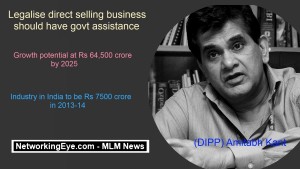
    MLM Growth potential at Rs 64,500 crore by 2025

    Legalise direct selling business, should have govt assistance: Amitabh Kant

    Says industry has enormous growth potential.

    Direct selling should not be equated with fraudulent financial schemes and should gain government recognition and proper legislation, Department of Industrial Policy and Promotion (DIPP) Amitabh Kant said on Tuesday.

    Speaking at an event about direct selling – the marketing and selling of products directly to consumers away from a fixed retail location, by industry body Federation of Indian Chambers of Commerce and Industry (Ficci), Kant said the industry had enormous growth potential.

    Stressing that it was a public business and not ponzi schemes, a number of  which have recently been uncovered in eastern states, Kant called for increased government supervision and assistance in the industry.

    “Government needs to be made literate about issues regarding direct selling”, he said. He added DIPP has already sent the draft guidelines on direct selling to the department of consumer affairs, which is the nodal authority for all legislation on the matter, for state level implementation.

    In the absence of a proper legal framework, Kant said local administration like tax officials and police need to be educated more to help direct selling which has produces large scale employment.

    A report on the industry by international business advisor and auditor KPMG, released at the event, pointed out the size of the industry in India to be Rs 7500 crore in 2013-14.

    Although currently, direct selling accounts for around 0.4 per cent of all retail sales in the country, the report pegged its growth potential at Rs 64,500 crore by 2025.

    The market for direct selling managed to grow at an impressive compounded annual rgrowth rate of 16 per cent in the last five years.

    The total international market size is $ 180 Billion and involves consumer products major Amway, cosmetics manufacturer Avon and health supplements maker Herbalife.


  • Women form a significant chunk of direct sellers in India

    Women form a significant chunk of direct sellers in India

    Direct selling, a lucrative opportunity for many

    While door-to-door selling is a common phenomenon is many localities, the numbers have increased indicating a rise in its potential, especially for women in India. Direct Selling provides accessible business opportunities to people looking for alternative sources of income, and whose entry is generally not restricted by gender, age, education, or previous experience.

    According to Annual Survey Report, women contribute almost 58.3 per cent in 2013-14. “Women form a significant chunk of direct sellers, and from a current 2,551,189 women, their numbers is expected to grow at eight per cent making a whopping 55,07,820 self-employed women by 2025,” informs Chavi Hemanth, secretary general, Indian Direct Selling Association (IDSA).

    The IDSA which is an autonomous, self-regulatory body recognises the marketing approach as micro-entrepreneurship that can inspire many small home-based initiatives. Hemanth tells Metrolife, “Initially FMCG or everyday use products were more popular but segments like wellness, cosmetics and personal care dominate the Indian direct selling market which has accelerated women self-employment and empowerment. This year, the industry focus is to further bolster and showcase the entrepreneur opportunity for women.”

    Hemanth adds that it is interesting to note that women percentage of full-time self-employed of direct sellers stands at 64 per cent and part-timers of direct sellers stands at 36 per cent. Being in the Indian set-up, “Direct selling gives educated and semi-educated women the flexibility to manage their professional and personal lives.”

    Dr S P Sharma, chief economist-director research, PHD Chamber of Commerce and Industry says, “Women have significantly contributed in the economic empowerment of nation over the years. The concept of gender equality has gained momentum in light of globalisation and liberalisation and there has been a phenomenal change in the status of women over the years across the globe. Women who used to undertake only household responsibilities earlier are now effectively participating in almost all sectors of the economy. These self-employment opportunities will encourage more women.”

    Hemanth tells Metrolife, “It is always not about money. But how confident you are as a woman. Once they start going out, they get motivated.”

    source: deccanherald

  • Direct Selling sector as a retailing medium in India is yet to gain momentum

    Direct Selling sector as a retailing medium in India is yet to gain momentum

    #DirectSelling #Retail #Amway #Oriflame #Tupperware

    The past history of direct marketing dates back to the days, perhaps, when we used to acquire vegetables as well as family products from the cart vendors. Gradually, the principle as a tool of selling gained approval, yet, the section has actually not attained its best position in the country. A closer Look!

    Direct selling is a worldwide market, running in over ONE HUNDRED nations, with a market dimension of USD 167 billion. It describes the selling of products and services to the customers, far from a taken care of retail outlet, normally in their residences, work environment etc, via description and demo of the item by direct sellers. (more…)

  • Indian Direct selling sector anticipates higher growth
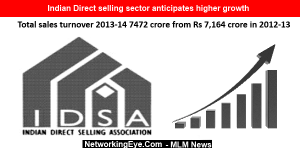
    Indian Direct selling sector anticipates higher growth

    #IDSA #PHDCCI #DirectSelling #MLMNews

    The Indian Direct Selling Association (IDSA) on Thursday stated the direct selling industry is again moving forward this year as compared with an adverse growth in 2013-14.

    The IDSA in association with PHD Chamber of Commerce  (PHDCCI) released the yearly survey record for 2013-14 on the direct selling sector, according to which the total sales turnover grew simply 4.3 per cent in 2013 as compared with a 12 each cent rise in the previous year. (more…)