Tag: tupperware

  • Indian government to soon issue the guidelines for Direct Selling Industry

    Indian government to soon issue the guidelines for Direct Selling Industry

    Key Highlights:

    • Indian Government to regulate new guidelines barring entry fee to a direct selling/network marketing /MLM company
    • All direct selling companies operating in India to comply with the new guideline within 90 days
    • The guidelines to specify the cooling period for both the direct selling company and the agent

    NEW DELHI: Guidelines prepared by the consumer affairs ministry to regulate the sector reveal that Direct selling companies like Amway, Oriflame and Tupperware will be barred from levying  any entry fee on their agents or pressing them to buy back unsold inventory as per TOI.

    The companies will also have to guarantee a full refund or buy back products and services sold to their independent representative. This will safeguard thousands of housewives and professionals who work part-time as agents.

    The policy is expected to help end the ambiguity between a direct selling firm and a “pyramid scheme.”A typical pyramid scheme is a business model which encourages recruitment of members with the promise of commission for enrolling others into the scheme without any actual sale of products or services.

    The direct selling industry has been urging the Indian Government to amend the existing Price Chit and Money Circulation Schemes (Banning Act) 1978 and to come up with a clear legislation that will differentiate them from “pyramid” schemes. According to the industry , “pyramid schemes” companies  are  not registered with the  local authoritarian bodies in the country they operate in, neither do they obtain the license under existing laws of the land, unlike the direct selling companies.

    According to a report by ICRIER (Indian Council for Research on International Economic Relations) between 2004 and 2009, the direct sellers in India have almost doubled. The report also stated that in 2009-10,India ranked 11th among the top direct selling countries.

    In the absence of a clear legislation, the direct selling industry has suffered a lot and has often been confused with pyramid schemes. The industry is known to offer self-employment opportunities to individuals and is spreading to Tier 1 and 2 towns across the country. The direct selling industry is expected to reach Rs.15-20 billion by 2025

    Currently, individuals who wish to become agents or independent representatives with a direct selling company have to pay a certain amount towards their registration as agents, as well as, buy some products for selling. The agents are expected to buy back the products in scenarios where they fail to sell them which puts an extra burden on them.

    The new guidelines are expected to be rolled out soon and the states will be asked to implement them swiftly. All direct selling companies operating in India will have to comply with the norms within three months post the issue of the new guidelines which will also include mandatory registration with state government agencies. As per this proposed guidelines, direct sellers can only be engaged through a “legal contract.”

    As per the sources, the new guidelines will also specify the cooling period during which both the parties, i.e. a direct selling company and the agent, can request to cancel the contract and claim a refund. It is also expected that the companies will not resort to any form of misleading advertisement to attract consumers.

    As stated by an official, “the policy will take care of direct selling agents and consumers as well, which will include the manner in which companies operate and agents approach the consumers.”
  • FIR registered against Tupperware over mlm business model

    FIR registered against Tupperware over mlm business model

    An FIR was registered against the company officials for allegedly violating the Chits and Money Circulation Schemes Act

    Tupperware India, a leading kitchenware direct selling firm, along with its top honchos in India have approached the Punjab and Haryana high court challenging a first information report (FIR) by the Chandigarh Police for alleged violations of the Chits and Money Circulation Schemes Act.

    The FIR was registered in August against the company and its top management officials, including chief executive officer (CEO) Rick Goings, managing director, Tupperware India, Shilpa Ajwani among others on the complaint of a Chandigarh woman.

    Besides, Ajwani, Vandita Datta (director finance), Chandan Dang (director marketing), Jaideep Abhichandani (regional sales head north) and Michael Lazaro (head emerging markets), working at the Gurgaon corporate office of the company have been named in the FIR and are petitioners in the matter. Many of them have secured pre-arrest bail from the high court and permissions to visit abroad. The Chandigarh Police unsuccessfully tried to oppose the bails stating that these executives were not cooperating in the probe, standing counsel, UT, JS Toor said.

    The company has sought quashing of the FIR accusing the Chandigarh Police of abuse of “criminal process of law and launching avoidable and baseless criminal investigation” on vague allegations. It was purely a private dispute in which state (UT) is trying to be an arbitrator. The account of the company with the Royal Bank of Scotland has been frozen, the petitioners told the court.

    The company has submitted that the complainant woman “defrauded” it and stopped payment of outstanding amounts to the tune of Rs 25 lakh, part of it to be paid to former distributor. The company says the agreement was on non-exclusive basis, the woman knew the company also uses marketing facility through internet to reach out to the customers.

    The complaint, Seema Arya, is a distributor in-charge of the company products for Chandigarh, its neighbouring towns and Shimla. The woman had alleged that she was appointed as a sole distributor but the company products were being sold online and also through the company’s former distributor and others. This has resulted in loss of Rs 50 lakh to her.

    The next hearing in the matter is on October 29, when the Chandigarh Police have to respond to the allegations of abuse of criminal process of law by its officials.

    Apart from the allegations of violations various sections of the Prize Chits and Money Circulation Schemes (Banning) Act, 1978, the company and its top executives have been booked for alleged fraud and criminal breach of trust.

    The case

    The complaint, Seema Arya, a sole distributor in-charge of the company products for Chandigarh, its neighbouring towns, alleged that the company products were being sold online and also through the company’s former distributor and others. This resulted in a loss of Rs 50 lakh to her. An FIR was registered against the company officials for allegedly violating the Chits and Money Circulation Schemes Act.

    The company, however, has sought quashing of the FIR alleging that the complainant woman defrauded it and stopped payment of outstanding amount to the tune of Rs 25 lakh. The case will come up for hearing on October 29.

  • Amway’s priority is to engage with the government constructively: Anshu Budhraja

    Amway’s priority is to engage with the government constructively: Anshu Budhraja

    #Tupperware #Oriflame #Microsoft #FSSAI #AnshuBudhraja #Amway

    Even after being engulfed in the controversial arrest of its CEO, Amway refuses to give up its promising Indian Market. It has decided to come back even stronger by engaging in constructive participation along with the Indian government. The GDP of India’s direct selling market is around 0.08 per cent, which means that there is a huge potential of growth and once a clear guidelines are made, the Direct Selling Industry has the potential to grow from a current Rs. 7200 Crore to a whooping Rs.64500 crore by 2025. The Indian economy has also seen the raise in the demand of products patterning to wellness, cosmetics and personal care in the last couple of years. Keeping this in view Amway has decided to focus on manufacturing nutrition and cosmetic products in its Chennai based plant. This not only will cut down their import cost but will also reduce the cost of the products to their end customers which could be a good strategy in capturing the untapped Indian market – Networking Eye.


    Direct seller Amway India is looking to put behind it controversies stemming from the arrest of its top leadership over allegations related to various irregularities and regain growth momentum while charting out a new phase of engagement with the government.

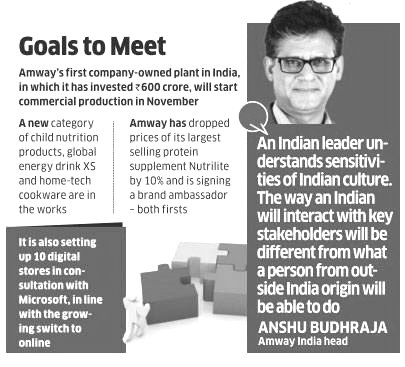
    Anshu Budhraja, the Rs 1,900-crore direct selling firm’s first India head in 16 years, said his immediate priority is to engage with the government constructively and take Amway forward from what he said is a “point of inflexion for the next growth phase.”

    Amway has consistently denied any wrongdoing on its part. “An Indian leader understands the sensitivities of Indian culture,” Budhraja said in an interview. “He has the benefit of growing up and being part of system. It’s very simple… the way an Indian will interact with key stakeholders will be different from what a person from outside India will be able to do.”

    Budhraja, who has been with the company for about 15 years in roles such as sales and finance, succeeded expat Bill Pinckney, who has relocated to a global role within the $10.8 billion Amway Corp.

    “China is a $30-billion direct selling industry, while in India direct selling is just 0.4 per cent of retail sales.That’s one big opportunity to double the numbers… it has a leverage of 10 times,” Budhraja said.

    Amway’s first company-owned plant in India, in which it has invested Rs 600 crore, will start commercial production in November.The India unit is looking to service Southeast Asian markets and turning itself into a regional product, innovation and research hub.

    “Commodity prices are the lowest in some time now like crude and some other sensitive raw material prices. This is the time to really leverage these. We are reducing dependency on imports,” Budhraja said. Amway’s import content is down to 1-2 per cent from 2025 per cent two years back, he said. The new plant will also make Artistry super premium cosmetics, which are currently being imported. Amway has dropped prices of its largest selling protein supplement Nutrilite by 10 per cent and is signing a brand ambassador both firsts. A new category of child nutrition products, global energy drink XS and home-tech cookware are in the works, he said.

    The company is also setting up 10 digital stores in consultation with Microsoft, in line with the growing switch to online. Amway India’s top line contribution to its parent is just 3 per cent, but it’s a top 10 market for the company in terms of growth and is targeting to be in the top three over the next decade. “We are targeting tripling turnover over the next 10 years and investing ahead of the curve,” he said.

    The Indian direct selling industry, which includes peers such as Oriflame and Tupperware, is about Rs 7,200 crore. “As the industry and players mature, and as the government’s awareness of the potential and economic and social impact of this industry matures, then you definitely have a playing field which I believe we are getting to,” he said.
    On food regulator Food Safety & Standards Authority of India (FSSAI) directing Amway to recall some products two months ago for allegedly selling them without approvals, Budhraja said, “There’s no conflict of interest with the FSSAI. It’s an education process which both of us are helping each other with. For a few products, we are looking at required changes.”

    Amway has a portfolio of about 50 products in nutrition, three or four of which have been affected. These are not top growth drivers, it said.

    The company has been an active participant in discussions with the government on the model that involves selling directly to consumers through distributors.

    “The ministry of consumer affairs has now taken complete ownership of issuing guidelines on direct selling,” Budhraja said.”Amway is making sure the ecosystem has the right facts and has a face who it can go to. That does make a difference. I have personally made it to all meetings we have had with the ministry of consumer affairs. I feel their level of understanding with the Indian piece is much better than what it was earlier.”

    source economic times

  • Direct Selling sector as a retailing medium in India is yet to gain momentum

    Direct Selling sector as a retailing medium in India is yet to gain momentum

    #DirectSelling #Retail #Amway #Oriflame #Tupperware

    The past history of direct marketing dates back to the days, perhaps, when we used to acquire vegetables as well as family products from the cart vendors. Gradually, the principle as a tool of selling gained approval, yet, the section has actually not attained its best position in the country. A closer Look!

    Direct selling is a worldwide market, running in over ONE HUNDRED nations, with a market dimension of USD 167 billion. It describes the selling of products and services to the customers, far from a taken care of retail outlet, normally in their residences, work environment etc, via description and demo of the item by direct sellers. (more…)

  • Modicare, Amway, DXN and K-Link are cutting down their operations in Kerala

    Modicare, Amway, DXN and K-Link are cutting down their operations in Kerala

    Companies such as ModicareAmway, DXN and K-Link have finally decided to decrease their presence at Kerala. One the biggest reason for doing so is due to authorities continuous harassment faced by their distributors and company officials.  A lot has changed after the arrest of Amway India Chairman and CEO William Pinckney.

    Authorities of the IDSA, which represents all the top direct sellers in the India, said distributors of many these business are being questioned by the state police at routine periods.

    “In case the situation does not improve for the operational feasibility aspects, few of them may consider to stop operating in the state of Kerala,” Chavi Hemanth, secretary-general at the IDSA.

    She also said,”The Indian Direct Selling Association is trying their level best to convince the government to provide a safe environment, where direct selling distributors can perform their regular business activities without getting harassed by the authorities”.

    According to Indian Direct Selling Association, the 4 southern states contributed 39 per cent to the Rs 6,385-crore direct selling industry in 2011-12, and some companies get up to 40 per cent of their profits from Kerala.

    Right now in India there is no specific law to control the direct selling industry and most Direct Sellers fear that.

    The biggest shock came when the Kerala police arrested and booked Amway India Chairman and CEO William S Pinckney and 2 business directors under Prize Chits and Money Circulation Schemes (Banning) Act.

    Earlier this year, American direct selling cosmetics firm Mary Kay completely stopped their operations in India citing lack of policy and law.

    A Modicare speaker stated the home-grown direct seller is dealing with business difficulties in Kerala due to unclear steps taken by different authorities. “A clear direction from the central Government on this front is much-needed for the growth of direct selling market.

    Amarnath Sen Gupta, IDSA chairman and Indian head of Malaysian direct seller DXN, stated the organization is constantly working out with the Kerala government, adding that the decision to continue operations in the state will depend upon exactly what regulation the government introduces. Companies that had active business in Kerala include Amway, Modicare, Tupperware, K-Link, DXN and Hindustan Unilever.

  • Tupperware Looking Forward To get into Online Sales

    Tupperware Looking Forward To get into Online Sales

    US-based direct sales company Tupperware is eyeing the online platform to sell its range of storage containers.

    Asha Gupta, Managing Director, Tupperware India, stated, “Since we already have about 1 million fans on our Facebook page, we want to take advantage of this by creating apps to recognize the nearby distributor for our clients. We have actually always been thinking about entering online selling officially for customer convenience.”.

    In the United States, Tupperware gets 2 per cent of its profits from online sales. In India it might be issue of time prior to it formally starts using it as an extra distribution network.

    In fact, some portals are already selling Tupperware items after obtaining items from its distributors. Its items are quickly spotted even at retail stores in spite of the business not being offered straight to retailers.

    Besides, Tupperware has also chosen to enter brand-new classifications such as water purifiers solely for the Indian market. It now plans to take its water purifier brand TupperSure to emerging markets such as Indonesia, South Africa, Russia and Brazil.

    Its water cleansers are manufactured at its centers in Dehradun and would possibly function as the base for supplying it to the remainder of the arising economies across the world.

    On categories such as cosmetics and nutraceuticals, Gupta stated “it may refer time however in the long term new categories such as nutraceuticals will get added”. In India, the southern markets continue to generate the bulk of sales for Tupperware. “In the south, customers are not price sensitive and are more quality conscious,” stated Gupta.