Tag: Indian Direct Selling Association

  • Decriminalization of MLM: its Importance and Issues

    Decriminalization of MLM: its Importance and Issues

    June 8 was an important date for many entrepreneurs because that was the day when the Department of Financial Services issued the new notification with the comments from stakeholders about the decriminalization of several laws and provisions as a result of which many people became interested in it, especially the ones working in the legal or business spheres.

    Although most people became interested in the specific act: Negotiable Instruments Act and the decriminalization of the offence of cheque bounce. One more important change mentioned in the notification is the possibility of decriminalization of the schemes of money circulation that can be punished under Sections 4 and 5 of the Prize Chits and Money Circulation Schemes (Banning) Act, 1978 so it leads to the serious step further in the development of the MLM sphere.

    Rich Dad Poor Dad

    It is not difficult for human beings who have some basic knowledge to see the MLM scheme at the first onset. Maybe you know a person who is always very excited about the «Rich Dad Poor Dad» book and suggests it to you all the time, or maybe a person who used to be your classmate suddenly asks you to come for a meeting in a hotel or a special centre and promises that the information that will be given to you will make you understand everything about successful business, or your relative phones you all the time trying to explain that you can spend your money to earn a huge amount of money.

    It is obvious that there are people who earned a lot using MLM schemes, but also there are many people who couldn’t earn anything, many of them even lost their money and became really upset. However, even if it is impossible to prove statistically, most people decided not to work with these schemes. 
    Decriminalization of MLM its Importance and Issues

    Such MLM pitches can get you into several situations: you can be connected with MLM, or you can be arranged into the direct selling process, or you may be involved in a pyramid scheme. It is proved that a pyramid scheme is a fraud because those who offer you getting in it say that you will only need to pay a little bit for your membership and then say that you will bring your invested money back and earn a lot after recruiting other members who will recruit new members, and so on.

    Every big country has strict laws regarding the necessity of punishment for these pyramid schemes. However, it is extremely hard to distinguish where is the standard MLM company and where is a pyramid scheme.

    MLM and pyramid schemes.

    The Prize Chits and Money Circulation Schemes act 1978

    The Prize Chits and Money Circulation Schemes (Banning) Act was created in 1978 in India, so MLM companies in this country have been struggling with the hard end of the law. The law uses a very wide definition of money circulation schemes and it explains them as schemes because of which a person receives money from a new member of the scheme and says he will pay this new member money if he can recruit other members, no matter if the money paid can come from the membership money of these new members or not.

    It is obvious that advertising or creating the scheme of such a type is illegal but besides, it is also illegal to be a member of this scheme. If a person offences this law, he may be incarcerated for 3 years.

    When the CEO of a very famous MLM company got to prison several years ago as he violated the Act, the Indian Direct Selling Association, which works defending MLM companies, asked to make an amendment to this act. This association was trying to prove that the business of MLM company is based on selling goods.

    Such companies are not similar to pyramid schemes because in MLM companies all members can generate profits for themselves and for the members staying in the levels above by selling products, instead of recruiting new members like in pyramid schemes.

    The necessity of easy finding which is MLM and which is a pyramid scheme; the possible necessity of having a new law.

    Sellers that provide goods from their companies to consumers outside of a retail environment, for example, a store, or a special marketplace can be called «direct sellers». For selling anything they contact customers person-to-person and they will definitely need to find some distributors to develop the business. It is impossible to criminalize the fact of recruiting new members nowadays. The proposal regarding decriminalization was created to develop businesses that suffered a lot because of the slowdown caused by Covid-19 and quarantine.

    The only thing that could be more effective for the development of direct selling and MLM than decriminalization is if the act can have modification with the guide to distinguish genuine companies using MLM and pyramid schemes that use people illegally.

    The Prize Chits and Money Circulation Schemes (Banning) Act was signed about 40 years ago. During previous decades, India was developing in the corporate law sphere and securities regulations extremely fast which now have useful tools and methods to detect and stop pyramid schemes.

    The Standing Committee on Finance of the Lok Sabha created the 21st report in September 2015 where it recommended 2 main steps to support direct sellers and MLM.

    • The first step is making the official registration required for all direct selling processes facilitated through the main regulatory body. 
    • The second step is creating an understandable definition of direct selling which will help to distinguish it from any pyramid scheme.

    Based on that report, the government made the Direct Selling Guidelines 2016 with the definitions of direct selling and pyramid schemes. However, these definitions are circular because the direct selling companies rely upon such companies working without using a pyramid scheme, while the pyramid schemes rely upon the scheme which is not connected with a direct selling company. Besides, these definitions lead to the confrontation with the Prize Chits and Money Circulation Schemes (Banning) Act.

    The act, in general, doesn’t allow to get any benefit or income for recruiting new members, while that new guideline allows such benefits if they were caused by selling goods. 

    Simple decriminalization will lead to the fact that people will be vulnerable to pyramid schemes.

    Besides, it can worsen the trust deficit situation for people working in this sphere, because they won’t be able to understand what is a direct seller, what is MLM, and what is a pyramid scheme. It is possible to implement all recommendations created by the Standing Committee on Finance and solve the conflict between the Act and the guidelines by creating a new law and elimination of 1978 Act, along with an accreditation system of these schemes, as a result of which businesses will finally develop again and the public interests will be protected as well.
    kindly share your opinion on the above article.

  • Government holds the bill to check the ponzi scheme

    Government holds the bill to check the ponzi scheme

    The government has put on hold the review of the ponzi scheme bill,which was suppose to bring about more clarity to distinguish between a genuine MLM company and ponzi money circulating companies.

    A week after the arrest of Amway India chief executive Bill Pinckney, the Indian Direct Selling Association has sought amendments to the Prize Chits and Money Circulation Schemes (Banning) Act, 1978, to protect legitimate direct selling.

    The Finance Ministry had started the process to amend Prize Chits and Money Circulation Schemes (Banning) Act, 1978 to check the menace of ponzi schemes which continue to defraud investors of their hard-earned money.

    The Ministry informed a recent meeting of representatives of central revenue intelligence and law enforcement agencies that the amendment bill “has been put on hold for the time being”, official sources said.

    It was also informed that an inter-ministerial group (IMG) formed under Additional Secretary, Department of Economic Affairs, is looking into all aspects including the amendment of the Act, they said.

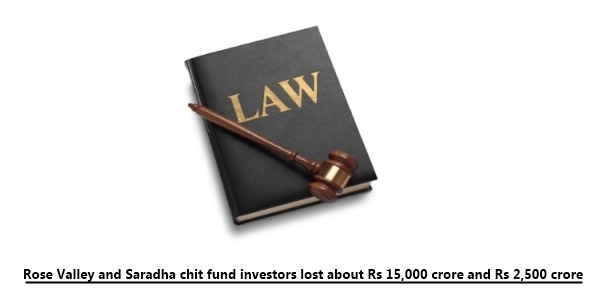
    A ponzi scheme is a swindle in which quick return on an investment is offered. Major such scams being probed by CBI, Income Tax and other investigating agencies include those relating to Rose Valley and Saradha chit fund wherein investors lost about Rs 15,000 crore and Rs 2,500 crore respectively on false promise of good returns.

    The Finance Ministry had earlier obtained comments from the industry on the amendments to the Act for a framework for regulation of MLM and pyramid marketing companies, the sources said.

    It had also written to Indian Embassies and High Commissions of select countries to gather relevant legal and regulatory framework, and industry practises for direct selling and MLM or ponzi schemes, they said.

    Sources said a Cabinet note will be prepared for the Bill’s introduction in Parliament after getting IMG’s recommendations and after considering other legal and regulatory issues.

    Meanwhile, a new set of Standard Operating Procedures (SOP) is being formulated by the government for central and state law enforcement agencies for probing ponzi schemes.

    The issue of ponzi schemes and ways to check them is regularly being discussed in meetings of Economic Intelligence Council, headed by Finance Minister Arun Jaitley, on intelligence sharing and financial crimes, they said.

    source: economictimes

  • Indian Direct selling sector anticipates higher growth

    Indian Direct selling sector anticipates higher growth

    #IDSA #PHDCCI #DirectSelling #MLMNews

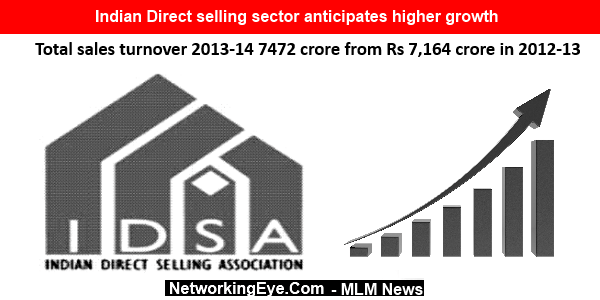
    The Indian Direct Selling Association (IDSA) on Thursday stated the direct selling industry is again moving forward this year as compared with an adverse growth in 2013-14.

    The IDSA in association with PHD Chamber of Commerce  (PHDCCI) released the yearly survey record for 2013-14 on the direct selling sector, according to which the total sales turnover grew simply 4.3 per cent in 2013 as compared with a 12 each cent rise in the previous year. (more…)

  • Ministry to clear regulatory grey areas on direct selling, e-commerce

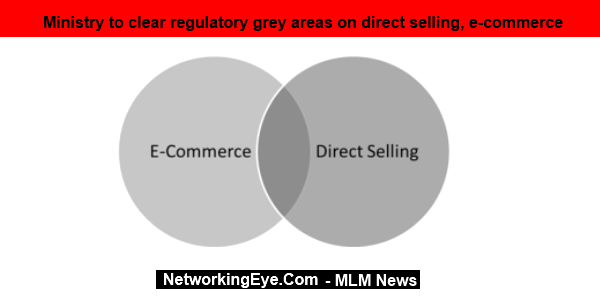
    Ministry to clear regulatory grey areas on direct selling, e-commerce

    Committee agenda

    While a committee comprising representatives from the Government departments concerned will meet to deliberate over direct selling norms on December 8, a proposal framed through joint consultation with other departments will be sent to the Cabinet Secretariat in a few days, an official source toldBusinessLine on Wednesday.

    Direct sellers under the Indian Direct Selling Association (IDSA) registered a turnover of over ₹7,400 crore in 2013-14, and have raised concerns over ‘murky’ government regulation, citing the inapplicability of the Prize Chits and Money Circulation Schemes (Banning) Act (1978) which, they say, does not distinguish between direct selling companies, such as Amway and Tupperware, and those engaging in investment-related frauds or Ponzi schemes.

    “The meeting will define what no-strings-attached direct selling that does not involve financial transactions, as in a business relationship, actually is and the scale of activity. Legitimate models, that are not money-making schemes, will be regulated under the Consumer Protection Act (1986),” said an official.

    The consensus at the Ministry’s meeting with officials from the Department of Financial Services (DFS) earlier was that the ‘Amway model’ was not a simple buyer-seller transaction, such as other door-to-door sales or e-commerce purchases. The DFS will also participate in the committee meeting.

    Fastest growing market

    “The model is different since one must buy the products from a company and sell these to consumers as an agent. A commission is paid on the basis of performance. There’s a difference between buying from a seller and ending a transaction and becoming an agent for a large company. It ceases to be a consumer issue since it’s a business relationship. Such players must consult the DFS,” he explained.

    He added that the Ministry will only examine the necessity of regulation where buyers and sellers interact without an intermediary.

    Following Junior Consumer Affairs Minister Raosaheb Patil Danve’s statement that e-commerce companies will be covered under the Consumer Protection Act, the Ministry proposal will seek delegation of regulatory responsibility of the online sales space to a specific department.

    “We will undertake it if we are directed to. There is a grey area at present about who in the Government is responsible for e-commerce regulation. It’s not just us, the Department of Industrial Promotion and Policy (DIPP) and Information Technology Department (DoIT), for instance, have serious things to say,” said the official. Representatives from the Ministries of Commerce and Micro Small and Medium Enterprises will also participate in framing the proposal.

    It is also believed that no new regulatory mechanism may be recommended from the consumer protection viewpoint if it is found that cases can be tackled through consumer forums.

    According to a Nomura report published in July, the domestic e-commerce market, among the fastest growing in the Asia-Pacific region, is likely to be worth $43 billion by 2019.

    the hindu

  • The Indian Direct Selling Association – IDSA

    The Indian Direct Selling Association – IDSA

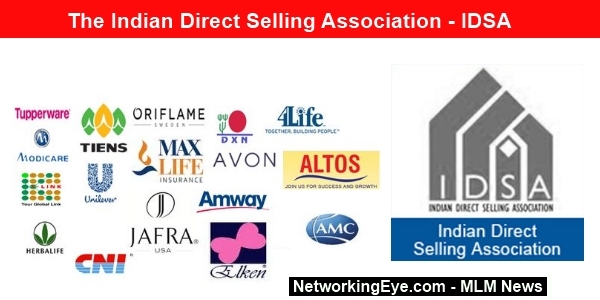
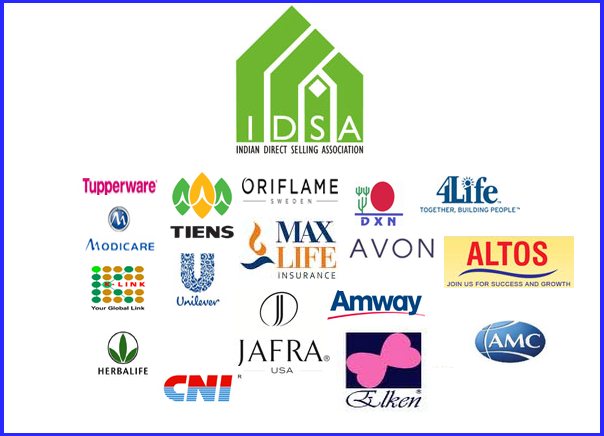
    The Indian Direct Selling Association (IDSA), a body that governs 18 of the largest direct selling companies in India. Right now there is no law on mlm in India. Due to the absence of proper law to understand MLM, lot of direct sales companies are facing problems.  IDSA wanted the government to enact a law to prevent ponzi MLM/Direct Sales/Network Marketing companies from taking gullible people for a ride .

    IDSA is an Amway‘s initiative and it is an autonomous, self regulatory body for the direct selling industry in India. The Association acts as an interface between the industry and policy – making bodies of the direct selling industry in India.

    Guidelines For The MLM Companies:

    Here are few IDSA guidelines for Direct Selling Company-:

    • The code contains sections entitled “Conduct for the Protection of Consumers”. ”Conduct between companies and Direct Sellers” and Conduct between Companies”. These three sections addresses the varying interactions across the spectrum of direct sales .The code is design to assist  the satisfaction and protection  of consumers, promote fair competition within the framework of free enterprises and enhance the public  image of Direct Selling.
    • This Code covers all of Indian Direct Selling Association (IDSA) members, their staff, contractors, distributors, agents and independent sales consultant /Direct Sellers, including full and associate members while engaged  Direct Selling, for the sale of either products or services.
    • A member of IDSA may terminate their and their obligations to adhere to the code by resigning formally from the IDSA giving fourteen days’ notice. This however does not negate the obligation by the members to fulfill obligations incurred during the period of their membership.
    • Obligations to comply with the code shall not cease until the last obligations to do anything required by the code has been performed.
    • Companies and Direct Sellers shall accomplish consumer order in a timely manner.
    • Companies shall provide their Direct Sellers a 30 days of cooling period which will entitle her/him to refund of any entry fee paid upon his resigning and returning all material’s received by him at the end of joining.
    • All companies are required to publicize IDSA‘s Code of Ethics to their Direct Sellers and consumers.

    Indian Direct Selling Association (IDSA) Company List:

    1. Amway India Enterprises( Head Office: Noida, UP) : “Best To Believe” means the company that can fulfill each and every needs and can stand well on the customers requirement.Amway can be compared to a tree with several parts, each playing  a vital and healthy role.Amway is actively present in the formation of cosmetic to home-care products.
    2. Tupperware : Tupperware has made a pavement between people and profession. It’s a company  which manufactures and sell product like bottles ,tiffin’s ,bags, kitchen product etc. and also keeps in mind need of all ages.
    3. Avon : Avon is one of the most renowned company of beauty products in India.Beauty signifies women but Avon is also taking its step towards e-products which can be used by children and men also.For example – launch of bicycles.
    4. Tianjin Tianshi India Pvt. Ltd. : Tianjin is leading companies of IDSA .It provides healthy food supplements and also helps in development of  an eco-friendly environment.
    5. Oriflame : Oriflame always tries to make a” Flame of Innovation” by distributing skin care products and other electronic things for both men and women.
    6. Hindustan Unilever Network : Hindustan Unilever Network has covered more than 75% of today’s  daily need products either soaps or shampoo & others.Its branch are widely spreaded in each and every product.
    7. C.N.I Enterprises Pvt. Ltd. : C.N.I is a company with homogenous mixture of different products. The growth of company encourages the power of achievement.
    8. A.M.C Cookware Pvt. Ltd. : Only beauty products cannot lead the companies to a higher level and this is proved by A.M.C cookware .The company focuses its attention on the growth kitchen appliances which shows a different sign of innovation.
    9. Altos Enterprises Ltd. : Acne, pimples, wrinkles are major problem faced by today’s generation. So, Altos gives the best products to its customers by seeking nature’s best source.
    10. 4Life Trading India Ltd. : The thought of the company is to give benefits of healthy life with a healthy income.
    11. Jafra Ruchi Cosmetics India Pvt. Ltd. : The company aired in 1956 bringing new ideas to India concerning about finance and products. It also tried to bring enhancement in the field of beauty products by giving windows to girls in the world.
    12. Herbalife International India Pvt. Ltd. : The term’ Herbal’ means natural medicinal herbs .The company tries to bring use of natural as well as nutritional and healthy products to people’s lives, though serving the motto of ‘Seed To Feed’.
    13. Elken International India Pvt. Ltd. : Under ISO 9001 Certified company has a cycle chart of T3-Trusted To Care ,Trusted To Nurture ,Trusted To Lead.
    14. Modi Care Ltd. : Modi care is one of the oldest Indian MLM Company and it is also the most renowned company in IDSA. The company not only deals with home or cosmetics care products but also focuses upon agricultural products by providing good fertilizers which helps to bring healthy nutrition .
    15. Max Life Insurance Co.Ltd. : It is a private sector company which aids financial service to its customers.Being on top 4th position among private insurers it offers protection to 30 lakhs customers.
    16. K-Link Health Care Pvt. Ltd. : K-LINK creates a link between customers and shareholders ,shareholders and staffs, staffs and distributors. The company also tries to create awareness in the society.
    17. Glaze Trading India Ltd. : The company stands for “For You Forever”.  The Glaze Trading has made a reputed position in last 10 years by dealing with handful of cosmetic ,home ,dental and skin care.
    18. Daeshan Trading Pvt. Ltd. : The company says the people to enjoy their life with wholesome of nutrition and healthy life by creating financial stability.

    More you can read here: http://www.idsa.co.in/members.html


    Indian Direct Selling Association Membership:

    Several companies can get membership in IDSA on the following basis-:

    • The methods of operations are fair and comply with the Model Code of Ethics and all relevant Indian legislation.
    • The company and its promoters should be sound financial standing .The Company must sign to abide by the Model Code Of Ethics.
    • The company should submit all the fees required by the Association.
    • The company must submit all required documents for scrutiny along with completed application form.
    • Company shall not use misleading, deceptive, or unfair recruiting practices in their interactions with prospective or direct sales.
    • All financial due shall be paid and any withholdings should be made in the commercial manner.


    Challenges faced by Indian Direct Selling Association:

    Indian Direct Selling Association catalyses’ change by working closely with government on policy issues, enhancing, efficiency and ushering in desired credibility, clarity & confidence in Direct Selling.

    IDSA strives to create and further an environment conducive to the growth of Direct Selling industry in India, partnering industry and government alike through advisory and consultative activities.  There are few issues faced by IDSA.

    ChallengesSuggestions
    High incidence of fraudulent companiesStricter registration policy by Government
    Absence of regulatory law/guidelinesImplementation of a single standard workable policy
    Lack of training and orientation for leadersIncrease the number of leadership trainings
    Low environmental clearances, political risk,Implementation of a single standard workable policy
    and poor logistics and distribution channels 
    Poor leader motivationIncome enhancement
    Contagion effect of fraud companies on theImplementation of a single standard workable policy
    reputation of legitimate companies 
    AttritionIncrease the number of trainings provided
    Harassment by authoritiesImplementation of a single standard workable policy
    Compliance of special guidelines for MLMReview the guidelines in terms of international MLM business
    issued by Kerala State governmentmodel and practices.
  • Modicare, Amway, DXN and K-Link are cutting down their operations in Kerala

    Modicare, Amway, DXN and K-Link are cutting down their operations in Kerala

    Companies such as ModicareAmway, DXN and K-Link have finally decided to decrease their presence at Kerala. One the biggest reason for doing so is due to authorities continuous harassment faced by their distributors and company officials.  A lot has changed after the arrest of Amway India Chairman and CEO William Pinckney.

    Authorities of the IDSA, which represents all the top direct sellers in the India, said distributors of many these business are being questioned by the state police at routine periods.

    “In case the situation does not improve for the operational feasibility aspects, few of them may consider to stop operating in the state of Kerala,” Chavi Hemanth, secretary-general at the IDSA.

    She also said,”The Indian Direct Selling Association is trying their level best to convince the government to provide a safe environment, where direct selling distributors can perform their regular business activities without getting harassed by the authorities”.

    According to Indian Direct Selling Association, the 4 southern states contributed 39 per cent to the Rs 6,385-crore direct selling industry in 2011-12, and some companies get up to 40 per cent of their profits from Kerala.

    Right now in India there is no specific law to control the direct selling industry and most Direct Sellers fear that.

    The biggest shock came when the Kerala police arrested and booked Amway India Chairman and CEO William S Pinckney and 2 business directors under Prize Chits and Money Circulation Schemes (Banning) Act.

    Earlier this year, American direct selling cosmetics firm Mary Kay completely stopped their operations in India citing lack of policy and law.

    A Modicare speaker stated the home-grown direct seller is dealing with business difficulties in Kerala due to unclear steps taken by different authorities. “A clear direction from the central Government on this front is much-needed for the growth of direct selling market.

    Amarnath Sen Gupta, IDSA chairman and Indian head of Malaysian direct seller DXN, stated the organization is constantly working out with the Kerala government, adding that the decision to continue operations in the state will depend upon exactly what regulation the government introduces. Companies that had active business in Kerala include Amway, Modicare, Tupperware, K-Link, DXN and Hindustan Unilever.

  • IDSA Demands for direct selling law; Global MLM CEOs to visit India

    IDSA Demands for direct selling law; Global MLM CEOs to visit India

    In order to promote a separate legislation for the direct selling market in India, top global executives of such mlm companies would be visiting India later on this year.

    “The CEO council of World Federation of Direct Selling Associations (WFDSA) would be involving India for the first time.

    “This is to go over road map of direct selling industry in India as well as to meet various stakeholders to set up a case for a separate legislation for the mlm market,” Indian Direct Selling Association (IDSA) secretary-general, Chavi Hemanth said.

    She included that the CEO Council members would be meeting various ministry officials, consisting of those from finance and consumer affairs, throughout their India visit.

    Founded in 1978, WFDSA has around 60 members, consisting of Avon, Amway and Herbalife and the CEO Council is the main governing body of the federation. IDSA is also a member of the WFDSA.

    “We expect around 10 CEOs out from a total of 30 council members to come to India to attend the WFDSA meeting,” Hemanth said.

    IDSA has actually been seeking a separate regulatory structure for the mlm sector in order not distinguish from any fraudulent pyramid and ponzi schemes.