Tag: amway

  • Amway India Appoints Ajay Khanna as Chief Marketing Officer

    Amway India Appoints Ajay Khanna as Chief Marketing Officer

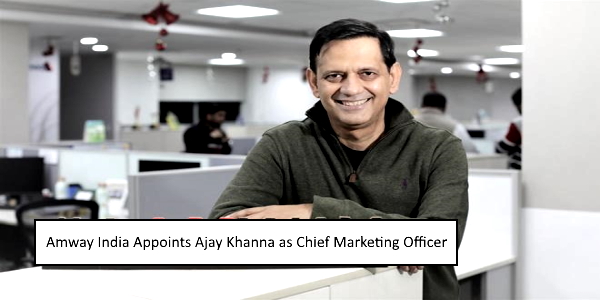
    Khanna has taken over the reins from Sundip Shah and will will report to Anshu Budhraja. Ajay Khanna joined the organisation in 1998 and donned many hats in various capacities

    Direct selling FMCG company Amway India has appointed Ajay Khanna as the chief marketing officer. With over 24 years of experience in the FMCG and Telecom industry, Khanna has taken over the reins from Sundip Shah, former CMO, who will embark upon an entrepreneurial journey after spending nearly three decades in the corporate world. Based in Amway India’s headquarters in Gurugram, Ajay Khanna will report to Anshu Budhraja, CEO, Amway India.

    With deep understanding of India’s dynamic marketing environment as well as the direct selling industry, Khanna has contributed to the remarkable success of Amway’s nutrition and consumer durables categories, Anshu Budhraja, CEO, Amway India, said.

    According to Ajay Khanna, chief marketing officer, Amway India, India is a top priority market for Amway globally. “The evolving market dynamics, along with our differentiated sales channel, makes it an opportune time to introduce innovations for business growth. I look forward to further building the growth momentum created by my predecessor Sundip Shah and taking the business to greater heights,” he added.

    An Amway veteran, Ajay Khanna joined the organisation in 1998 and donned many hats in various capacities. His trajectory with the company includes leading growth of the home-care/personal care, agriculture and insurance categories before taking on the category head role for the company’s biggest business category – nutrition and wellness in 2014. Armed with a deep understanding of India’s direct selling industry as well as the dynamic consumer landscape, Khanna has been instrumental in driving growth for Amway’s nutrition brand– Nutrilite, and consumer durables in addition to driving effective collaborations with the company’s direct sellers and cross-functional teams. Under his leadership, Amway team has engineered many successes such as the Nutrilite campaign with a brand ambassador, the best in class Amway Queen (cookware) launch, successful foray into Herbals through the Nutrilite Traditional Herbs range as well as into the consumer durables segment.

    source

  • Amway takes concrete steps to triple its turnover in next decade

    Amway takes concrete steps to triple its turnover in next decade

    Key Highlights:

    • Amway to add 8 more products to its existing product lines

    • Decides  to  explore newer avenues like the experience stores and e-commerce to increase turnover

    • Plan to launch an app with no  tie-up with the existing e-tailers like Flipkart or Amazon

    DELHI : One of the leading and oldest  FMCG direct selling company ,Amway plans to add new product lines especially targeted for Indian customers in 2016 . This will likely result in a double-digit growth in FY17 in cookware, health, nutrition and skin care segments showing India’s importance for the parent as per the reports from Edelweiss.

    The report also said that Amway plans to triple its turnover by 2025.

    Currently in terms of growth rate India is considered amongst the top four markets. This new strategy is expected to figure India amongst the top three in the coming five years. The market growth in Japan for Amway has been at 2% and Korea at 5%. Other global markets like Brazil, Malaysia, Mexico and some pockets in the US have shown good double-digit growth whereas market in Thailand has been flat.

    Bhuvan Kapur, Amway vice president (north), said that the company would add 8 more products this fiscal year.Currently, Amway has over 140 products in five major categories –personal care, nutrition & wellness, cosmetics, home care, and great value products. 70% of their revenue is credited to the first two categories of product.

    As per the report Nutrilite, which constitutes 50% of the company’s turnover in India, has recently taken Farhan Akhtar as their brand ambassador.  The report also stated that the company has also set aside INR 1 billion for setting up 10 to 12 experience stores. These stores are said to be in partnership with Microsoft and will be utilized to showcase its range of products to distributors, business partners and customers.

    Beside this Amway also has e-commerce presence through its existing website and is said to contribute about 30-35% of the total Indian sales. The company also aims to take this number to 55% in next ten years. In the other global markets like the US and South Korea, the company’s online sale constitutes about 70 -80% of sales and the company is setting these countries as their benchmark.

    Further the company also has plans to launch an app in coming months and has no plans to tie-up with the existing e-tailers like Flipkart or Amazon and plans to remain a B2B player said the report.

    The company is committed to manufacturing all its products locally following the Government’s “Make in India” campaign in India and has also set up its manufacturing facility in Tamil Nadu.

    The report also confirmed that it currently has five million independent agents and it plans to increase this number to 18 million in the coming next ten years.

    About Amway:

    Amway, earlier known as The American Way, is an American company founded in 1959 by Jay Van Andel and Richard DeVos. It uses a multi-level marketing model to sell its products. Its product lines include home care products, personal care products, jewelry, electronics, Nutrilite dietary supplements, water purifiers, air purifiers,  insurance, and cosmetics. Amway has its global presence in more than hundred countries around the world.In 2012 Amway ranked No.26 amongst the largest private companies in the US by Forbes. 

  • Indian government to soon issue the guidelines for Direct Selling Industry

    Indian government to soon issue the guidelines for Direct Selling Industry

    Key Highlights:

    • Indian Government to regulate new guidelines barring entry fee to a direct selling/network marketing /MLM company
    • All direct selling companies operating in India to comply with the new guideline within 90 days
    • The guidelines to specify the cooling period for both the direct selling company and the agent

    NEW DELHI: Guidelines prepared by the consumer affairs ministry to regulate the sector reveal that Direct selling companies like Amway, Oriflame and Tupperware will be barred from levying  any entry fee on their agents or pressing them to buy back unsold inventory as per TOI.

    The companies will also have to guarantee a full refund or buy back products and services sold to their independent representative. This will safeguard thousands of housewives and professionals who work part-time as agents.

    The policy is expected to help end the ambiguity between a direct selling firm and a “pyramid scheme.”A typical pyramid scheme is a business model which encourages recruitment of members with the promise of commission for enrolling others into the scheme without any actual sale of products or services.

    The direct selling industry has been urging the Indian Government to amend the existing Price Chit and Money Circulation Schemes (Banning Act) 1978 and to come up with a clear legislation that will differentiate them from “pyramid” schemes. According to the industry , “pyramid schemes” companies  are  not registered with the  local authoritarian bodies in the country they operate in, neither do they obtain the license under existing laws of the land, unlike the direct selling companies.

    According to a report by ICRIER (Indian Council for Research on International Economic Relations) between 2004 and 2009, the direct sellers in India have almost doubled. The report also stated that in 2009-10,India ranked 11th among the top direct selling countries.

    In the absence of a clear legislation, the direct selling industry has suffered a lot and has often been confused with pyramid schemes. The industry is known to offer self-employment opportunities to individuals and is spreading to Tier 1 and 2 towns across the country. The direct selling industry is expected to reach Rs.15-20 billion by 2025

    Currently, individuals who wish to become agents or independent representatives with a direct selling company have to pay a certain amount towards their registration as agents, as well as, buy some products for selling. The agents are expected to buy back the products in scenarios where they fail to sell them which puts an extra burden on them.

    The new guidelines are expected to be rolled out soon and the states will be asked to implement them swiftly. All direct selling companies operating in India will have to comply with the norms within three months post the issue of the new guidelines which will also include mandatory registration with state government agencies. As per this proposed guidelines, direct sellers can only be engaged through a “legal contract.”

    As per the sources, the new guidelines will also specify the cooling period during which both the parties, i.e. a direct selling company and the agent, can request to cancel the contract and claim a refund. It is also expected that the companies will not resort to any form of misleading advertisement to attract consumers.

    As stated by an official, “the policy will take care of direct selling agents and consumers as well, which will include the manner in which companies operate and agents approach the consumers.”

  • The Status of Network Marketing/MLM/Direct Selling in India

    The Status of Network Marketing/MLM/Direct Selling in India

    Key Highlights

    • The history of network marketing
    • Global industry size
    • Need of the hour for the direct selling industry to thrive and flourish in India

    What is Direct Selling and Network Marketing?

    Before we discuss or try to understand the current situation of Network Marketing /MLM or Direct Selling Industry in India, it is important to understand the Industry first.

    A simple definition of network marketing or Multi-level marketing (MLM) is that it is a marketing strategy wherein a company does not hire sales force or marketing team to market and sell its products. Instead, they have independent representatives who use their personal network to promote the goods and services of the particular company and make a certain percentage as commission on the overall turnover made by them and their team. Network Marketing enables the company to reach its potential customers that it might not otherwise be able to reach with a traditional online or offline marketing strategy.

    Network Marketing, also known as Multi-Level-Marketing is actually a part of the Direct Selling Industry. Direct Selling companies remove the traditional distribution channels in between the consumers and sell their products directly through their independent representatives. In this industry, a person can be a consumer, distributor or a network marketer. Consumers are the ones who only use the products and services from the Direct Selling Company. A distributor is typically someone who is a consumer and also sells the products and services directly to people and earns a retail commission for every sale he makes. Network Marketer is not only a distributor and must sell products and services directly, but also refers and trains other distributors to sell the products and services and build their own businesses. They not only earn retail commissions but also commissions for the total turnover generated by their entire Network.

    This allows people to leverage other people’s effort and earn residual income. So contrary to the misconception, in network marketing, no one is paid for recruiting people, but for the personal sales, one makes or for the overall turnover generated from one’s entire team.

    History of Direct Selling and Network Marketing

    The origin of direct selling or network marketing industry can be traced back to 1886 with the establishment of Avon. This model of direct interaction with the customers was hugely successful. An entirely new chapter of evolution was induced with the introduction of the multi-level marketing compensation plans (MLM plans) by Nutrilite in 1945. In this compensation plan, the individual representative got the opportunity of building their own business by refereeing new distributors into the business and earning revenue from their own sales and the sales of distributors they enrol.

    With its success, many companies adopted the MLM plan, including global players like Avon, Tupperware and Amway. The 1990s saw a growth in the global direct selling market with major players expanding globally and entering newer, promising markets like Brazil, China and India.

    Global Industry size

    As per the study conducted by FICCI and KPMG, Direct selling is a USD167 billion industry globally. Even though the industry grew at a low rate of 5.4 per cent in 2012, due to global economic slowdown,  as compared to the overgrowth rate of 19.7 per cent in 2011, the long-term growth projection of the industry remains robust.

    Industry size in India

    As per KPMG – FICCI report, the Indian market for direct selling or network marketing industry was estimated at Rs.7, 500 crores in 2013-14. It forms around 0.4 percent of the total retail sales in the country. This figure is still far lower than other comparable economies (one-half of direct selling market size of China and one-tenth of Malaysia). As per the reports from FICCI – KPMG Direct selling is likely to reach Rs.64,500 crore billion in India by 2025.

    Challenges In India

    In India, there are no laws or a regulating body for network marketing or Multi-Level-Marketing (MLM) business, hence, subjecting this industry to frequent criticism and lawsuits. The only law that India currently has is The Prize Chits and Money Circulation Schemes (Banning Act) 1978.

    To summarize what the Act says, in simple words, is that the Government legally bans any such schemes wherein the members are paid to recruit members, with no significant products or services to buy or sell and where there is a considerable amount of money collected from people just in exchange for a promise of future returns.

    With no proper law in place, this industry is often targeted with lawsuits of scam and fraud. Even companies which pay proper taxes for the turnover made by the business are unfairly targeted and scrutinized. The important point to be noted is that all earnings of the independent representatives are also taxed at the sources by the Government and yet the same company face problems in its operations in India and have to fight lawsuits in the courts for years without any results!

    The number one issue that is impacting the growth of the direct selling industry in India is the lack of clear legislation that gives clarity and regulates the activities of the direct selling industry. In the absence of such a law, some authorities, have confused or have formed a view that direct selling companies are covered under the provision of the Prize Chits and Money Circulation Schemes (Banning) Act, 1978. The truth be told, this Act in its current form, cannot distinguish between a genuine direct selling company from fraudulent activities such as the pyramid or Ponzi schemes. An amendment in the Prize Chits and Money Circulation Schemes (Banning Act) will create a favourable legal environment for the industry thereby protecting individuals.

    In India, the regulatory environment is also another challenge for the direct selling industry. Because of lack of legislation, often consumers complain is registered under the Prize Chits and Money Circulation Schemes (Banning Act) and are treated as a criminal offence, leading to arrests of key officials, individual representatives, offices getting sealed etc. Such situations send a negative message regarding the business operating environment in India. Many direct selling companies that operate in India face many operational problems, challenges, the allegation as well as media assassination. Companies like Mary Kay wounded up its Indian operations in 2013 citing regulatory environment as one of the reasons. At the point of time, Mary Kay had 2.5 million distributors in about 35 markets globally. In India, it had about 4,500 beauty agents and four third-party warehouses. Amway chairman and CEO, William S Pinckney, was also arrested in 2014 by the Andhra Pradesh Police based on a complaint of alleging unethical circulation of money through Amway’s operation. Other companies like QNET and the likes have also been in the news for illegally extracting money from people based on complaints registered under the Prize Chits and Money Circulation Schemes (Banning Act).

    In this light, it is also very important to understand that these companies are the same companies who globally function in markets with very strict direct selling and consumer protection policy like the USA, UK, Malaysia, Singapore, Vietnam, Dubai to mention a few. It is therefore of paramount importance that the Direct Selling companies and the government together find a legislative solution that will clearly differentiate a legitimate direct selling business from frauds and Ponzi schemes.

    The need of the hour is an amendment to the Prize Chits and Money Circulation Schemes (Banning Act). Direct selling industry did not even exist in India until the early 1990s and to expect that a law passed in 1978 will do justice to the industry is completely unfair. The Act was never intended to regulate direct selling industry, but the misrepresentation and misapplication of this Act has given the investigating authorities the power to seize, seal and arrest on receiving any complaints. This has proved catastrophic for the direct selling industry. Hence the importance of amending this act to clearly define a “pyramid schemes” and distinguish them from legitimate direct selling companies cannot be undermined. Besides this, it is also important that the Government pass new and separate legislation on direct selling. Many countries like Malaysia, Vietnam, South Korea, Indonesia, Japan, Singapore, Vietnam, and even Bangladesh have enacted a law for direct selling which has helped them in multiple ways.

    Separate legislation for the direct selling industry will not only clear the blurred lines between ethical industry players and impersonators but will also help in winning back the confidence of the consumers. As for the industry, it is in double jeopardy at the moment—corrosion of faith and an identity crisis.

  • Amway’s priority is to engage with the government constructively: Anshu Budhraja

    Amway’s priority is to engage with the government constructively: Anshu Budhraja

    #Tupperware #Oriflame #Microsoft #FSSAI #AnshuBudhraja #Amway

    Even after being engulfed in the controversial arrest of its CEO, Amway refuses to give up its promising Indian Market. It has decided to come back even stronger by engaging in constructive participation along with the Indian government. The GDP of India’s direct selling market is around 0.08 per cent, which means that there is a huge potential of growth and once a clear guidelines are made, the Direct Selling Industry has the potential to grow from a current Rs. 7200 Crore to a whooping Rs.64500 crore by 2025. The Indian economy has also seen the raise in the demand of products patterning to wellness, cosmetics and personal care in the last couple of years. Keeping this in view Amway has decided to focus on manufacturing nutrition and cosmetic products in its Chennai based plant. This not only will cut down their import cost but will also reduce the cost of the products to their end customers which could be a good strategy in capturing the untapped Indian market – Networking Eye.


    Direct seller Amway India is looking to put behind it controversies stemming from the arrest of its top leadership over allegations related to various irregularities and regain growth momentum while charting out a new phase of engagement with the government.

    Anshu Budhraja, the Rs 1,900-crore direct selling firm’s first India head in 16 years, said his immediate priority is to engage with the government constructively and take Amway forward from what he said is a “point of inflexion for the next growth phase.”

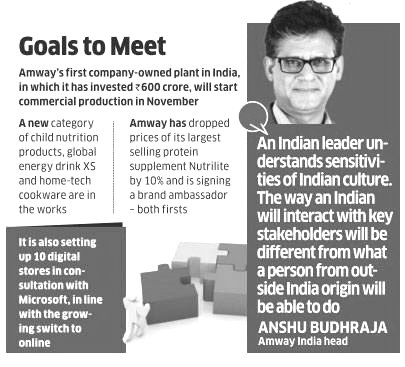
    Amway has consistently denied any wrongdoing on its part. “An Indian leader understands the sensitivities of Indian culture,” Budhraja said in an interview. “He has the benefit of growing up and being part of system. It’s very simple… the way an Indian will interact with key stakeholders will be different from what a person from outside India will be able to do.”

    Budhraja, who has been with the company for about 15 years in roles such as sales and finance, succeeded expat Bill Pinckney, who has relocated to a global role within the $10.8 billion Amway Corp.

    “China is a $30-billion direct selling industry, while in India direct selling is just 0.4 per cent of retail sales.That’s one big opportunity to double the numbers… it has a leverage of 10 times,” Budhraja said.

    Amway’s first company-owned plant in India, in which it has invested Rs 600 crore, will start commercial production in November.The India unit is looking to service Southeast Asian markets and turning itself into a regional product, innovation and research hub.

    “Commodity prices are the lowest in some time now like crude and some other sensitive raw material prices. This is the time to really leverage these. We are reducing dependency on imports,” Budhraja said. Amway’s import content is down to 1-2 per cent from 2025 per cent two years back, he said. The new plant will also make Artistry super premium cosmetics, which are currently being imported. Amway has dropped prices of its largest selling protein supplement Nutrilite by 10 per cent and is signing a brand ambassador both firsts. A new category of child nutrition products, global energy drink XS and home-tech cookware are in the works, he said.

    The company is also setting up 10 digital stores in consultation with Microsoft, in line with the growing switch to online. Amway India’s top line contribution to its parent is just 3 per cent, but it’s a top 10 market for the company in terms of growth and is targeting to be in the top three over the next decade. “We are targeting tripling turnover over the next 10 years and investing ahead of the curve,” he said.

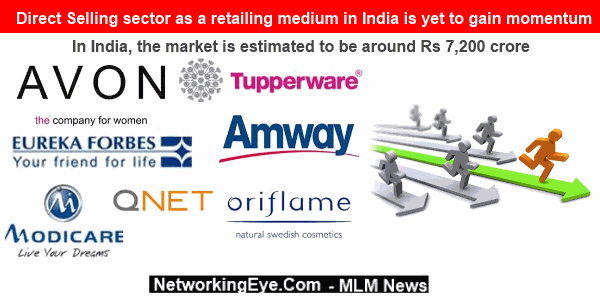
    The Indian direct selling industry, which includes peers such as Oriflame and Tupperware, is about Rs 7,200 crore. “As the industry and players mature, and as the government’s awareness of the potential and economic and social impact of this industry matures, then you definitely have a playing field which I believe we are getting to,” he said.
    On food regulator Food Safety & Standards Authority of India (FSSAI) directing Amway to recall some products two months ago for allegedly selling them without approvals, Budhraja said, “There’s no conflict of interest with the FSSAI. It’s an education process which both of us are helping each other with. For a few products, we are looking at required changes.”

    Amway has a portfolio of about 50 products in nutrition, three or four of which have been affected. These are not top growth drivers, it said.

    The company has been an active participant in discussions with the government on the model that involves selling directly to consumers through distributors.

    “The ministry of consumer affairs has now taken complete ownership of issuing guidelines on direct selling,” Budhraja said.”Amway is making sure the ecosystem has the right facts and has a face who it can go to. That does make a difference. I have personally made it to all meetings we have had with the ministry of consumer affairs. I feel their level of understanding with the Indian piece is much better than what it was earlier.”

    source economic times

  • Direct Selling sector as a retailing medium in India is yet to gain momentum

    Direct Selling sector as a retailing medium in India is yet to gain momentum

    #DirectSelling #Retail #Amway #Oriflame #Tupperware

    The past history of direct marketing dates back to the days, perhaps, when we used to acquire vegetables as well as family products from the cart vendors. Gradually, the principle as a tool of selling gained approval, yet, the section has actually not attained its best position in the country. A closer Look!

    Direct selling is a worldwide market, running in over ONE HUNDRED nations, with a market dimension of USD 167 billion. It describes the selling of products and services to the customers, far from a taken care of retail outlet, normally in their residences, work environment etc, via description and demo of the item by direct sellers. (more…)

  • Consumer Protection Authority open to regulate e-commerce, direct selling

    Consumer Protection Authority open to regulate e-commerce, direct selling

    #DirectSelling #RamVilasPaswan #MoneyCirculationSchemes #Amway

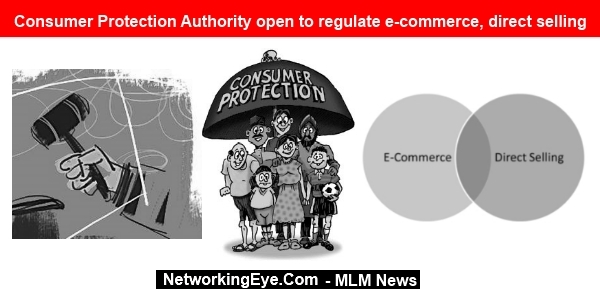
    A Consumer Protection Authority after amending the Consumer Protection Act (1986) was suggested by some representatives at the first meeting of an inter-Ministerial group chaired by the Ministry of Consumer Affairs (MoCA) to iron out issues related to regulating the e-commerce and direct selling space. (more…)

  • Amway’s fortunes dip in India

    Amway’s fortunes dip in India

    #Amway #MLM #DirectSelling #WilliamPinckney

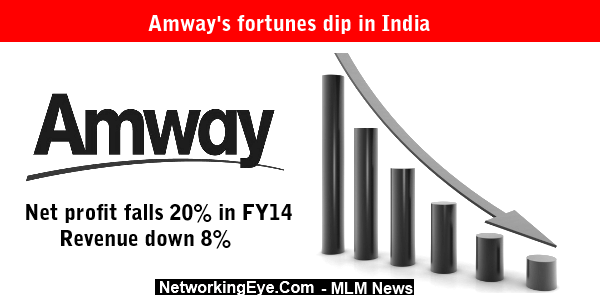
    Amid its run-ins with the police over direct-selling model, firm’s net profit falls 20% in FY14, revenue down 8%

    Amway, India’s largest direct-selling company, despite an annual drop of 20% in net profit and 8% in turnover in 2013-14, continues to be bigger than fast-moving consumer goods (FMCG) giants like Gillette and Emami in terms of revenue. (more…)

  • Amway says E-commerce to contribute half of sales in future

    Amway says E-commerce to contribute half of sales in future

    #Amway #TamilNadu #Sales #DirectSelling #MLM

    NEW DELHI: Direct selling company Amway, which is aiming Rs 6,000 crore turnover by 2020, today said it expects its e-commerce platform to contribute half of its sales in the future. (more…)

  • Amway Opportunity Foundation celebrates Amway Children & World Service Week

    Amway Opportunity Foundation celebrates Amway Children & World Service Week

    New Delhi: Amway has launched a world service week focusing on under privileged children of society to celebrate the 10th anniversary of Amway’s Global One by One Campaign for Children as well as 15th anniversary of Amway Opportunity Foundation in India.

    Amway opportunity foundation (AOF) is a registered NGO and deals with all corporate social responsibility (CSR) activities of Amway in India. It has been actively involved to transform the lives of blind children across 15 states and has reached to almost 85,000 school- going visually challenged children. With its partners, All India Confederation of the Blind (AICB) and National Association for the Blind (NAB) AOF has constantly tangled itself for working to ensuring the braille books availability at various schools.

    AOF has also channelized its energies in setting up 16 fully-equipped computer centers for visually challenged children in 16 cities. It also has been working for various other projects, “project sunrise” to name one, in which it joined hands with 40 partner NGOs and schools in different parts of the country and supporting them in health & education.

    Another noteworthy fact is about their “one by one campaign” in which Amway distributors and employees have impacted 10 million lives by volunteering for hundreds of projects. They include providing kitchen facilities to help prepare nutritive meals for children, supporting welfare centers, building homes for families, giving life-saving immunizations to children.

    To celebrate the twin anniversary AOF, in association with its 40 partner NGOs, will organize various social activities across cities including Delhi, Kolkata, Mumbai, Hubli, Guwahati, to mention a few. In Mumbai, the celebration will be featuring an exhibition-cum-sale of handmade products made by less privileged children; another attraction would be a special workshop for all kids and a puppet show.

    For Kolkata, there will be a hosting of a children’s fair which will include various activities like rally with visually challenged children, quiz competition and various seminars. In Hubli, AOF will celebrate Children’s week with a difference by organizing a kid’s fashion show, in association with Fashion design institute and partner NGO Channels of Love.

    Children of Delhi would be benefited by a mega health camp from 20th to 22nd of November which is going to touch close to 1500 children. Commenting on the occasion Mr. William S. Pinckney, Chairman, Amway Opportunity Foundation, said “My heart fills with joy watching the young children getting benefitted. Amway has been one of the prominent companies in the country making a difference to the lives of the under privileged and would continue to extend its support to the society at large.”