The co-founder of OneCoin, a fraudulent cryptocurrency scheme, has admitted guilt to several charges brought by the US Department of Justice (DOJ) and now faces up to 60 years in prison. Karl Sebastian Greenwood pleaded guilty to counts of wire fraud, conspiracy to commit wire fraud, and conspiracy to launder money, each of which carries a maximum potential sentence of 20 years in prison.
OneCoin was promoted as a “Bitcoin killer” by Greenwood and his business partner, Ruja Ignatova, but the tokens were actually “totally worthless” and part of “one of the greatest international fraud schemes ever committed”, according to U.S. Attorney Damian Williams. The company, based in Bulgaria, was actually a pyramid and Ponzi scheme, in which participants could bring others into the plan without a tangible product and later participants were compensated with funds from earlier participants. It presented itself as a multi-level marketing company, with members earning commissions for the sale of cryptocurrency packages that purportedly included OneCoin and the opportunity to mine additional coins. However, OneCoin could only be converted into fiat money on the exclusive Xcoinx exchange.
As the “global master distributor” of the fake company, Greenwood reportedly made about $21.2 million per month. Three million customers who bought the packages and invested over $4 billion are thought to have been duped by OneCoin. Ignatova, who is still at large and was last seen leaving for Athens, Greece in October 2017, was added to the FBI’s top ten most wanted list in June due to her involvement in the conspiracy.
Williams stated that Greenwood’s plea “sends a strong message” that the DOJ is “going after all those who want to exploit the Bitcoin environment through fraud.” Three associates are accused of fraud and money laundering in Germany, and other authorities have filed charges against people connected to OneCoin and Ignatova.
According to reports, thousands of people in India have fallen victim to a large-scale scam by a company called Hashpe. The victims claim that they were promised INR 3 lakh ($4,000) within 300 days in return for an initial investment of INR 1 lakh ($1,335). However, when they attempted to collect their earnings, they discovered that they had been cheated. It is estimated that around 5,000 investors lost a total of INR 200 crore ($26.7 million) to the company.
The scam is said to have been run using a multi-level marketing (MLM) method, similar to the one depicted in the Indian movie “Sathuranga Vettai.” Hashpe, which operated in Chennai and Coimbatore, promised to invest the money of its investors in cryptocurrency but instead used the funds to operate a pyramid scheme. The investors have filed a complaint with the Chennai Police, alleging that the company cheated more than INR 200 crore from 5,000 people.
According to the complaint, Hashpe encouraged its investors to recruit more people to join the company in exchange for commissions. The company also reportedly used the money invested by its clients to purchase TCX coins. Hashpe is said to have used endorsements from actresses Tamanna and Kajal Agarwal and conducted events at luxury hotels and on ships in order to attract new investors.
One victim of the scam told reporters that he had invested in Hashpe on the recommendation of a friend and based on his previous experience with other companies. However, the company’s main members, Imran, Babu, and Hitesh Jain, are accused of confusing investors by naming different types of coins and explaining their values, before ultimately withholding the promised returns. Investors from various states across India have reported being affected by the scam.
In addition to being cheated out of their investments, some victims have also reported receiving death threats from Hashpe’s authorities when attempting to get answers about their missing funds. The company is believed to have cheated more than INR 2,000 crore ($267 million) from investors all over India. Given the number of complaints and the amount of money lost, the case may be transferred to the Economic Offences Wing for further investigation.
Multi-level marketing (MLM) is a business model in which a company sells its products through a network of independent distributors, who earn commissions based on their sales and the sales of the distributors they recruit. While MLM can be a legitimate and profitable business opportunity for some, it has also been the subject of controversy and criticism in many countries, including India.
One of the main criticisms of MLM is that it can be used to operate fraudulent schemes. These schemes often involve distributors making exaggerated or false claims about the potential profits and benefits of joining the company’s network, and using high-pressure sales tactics to convince others to sign up. In some cases, the products being sold may be of low quality or overpriced, and the main focus of the company may be on recruiting new distributors rather than selling products.
There have been numerous cases of MLM fraud in India, with many people losing their hard-earned money after being lured into such schemes. In some cases, the companies operating these schemes have been shut down by the authorities, but they often re-emerge under different names, making it difficult to track and prosecute them.
One of the most well-known MLM frauds in India was the QNet scam, which was exposed in 2013. The company, which was operating under the name QuestNet at the time, was accused of running a pyramid scheme and defrauding thousands of people across the country. The company’s distributors were accused of using false promises of high returns and luxurious lifestyles to lure people into joining the network, and many people lost their savings after investing in the company.
Another infamous MLM fraud in India was the SpeakAsia Online scam, which was exposed in 2011. The company, which claimed to be a market research firm, was actually operating an illegal pyramid scheme, and its distributors were accused of using false claims and deceptive marketing tactics to recruit new members. The company was eventually shut down by the authorities, and many of its top executives were arrested and charged with fraud.
In recent years, the Indian government has taken steps to crack down on MLM frauds, and there are now several laws in place to protect consumers and prevent such schemes from operating in the country. However, it is still important for people to be cautious when considering joining an MLM company, and to thoroughly research the company and its products before making any commitments.
If you are approached by an MLM company or are considering joining one, here are some things to watch out for:
Exaggerated or false claims about the potential profits and benefits of joining the company.
High-pressure sales tactics or a strong emphasis on recruiting new members.
Poor-quality or overpriced products.
A lack of transparency about the company’s business model or financials.
A requirement to make a large upfront investment or purchase a large quantity of products.
If you suspect that an MLM company may be a fraud, it is important to report it to the authorities and seek legal advice. In India, you can report such schemes to the Ministry of Corporate Affairs, the Serious Fraud Investigation Office, or the local police. It is also a good idea to inform others about your experience, so that they can be aware of the potential risks and avoid being scammed.
In conclusion, while MLM can be a legitimate business opportunity for some, it is important to be aware of the potential risks and to be cautious when considering joining an MLM company. By doing your research and being aware of the warning signs of fraud, you can protect yourself and your hard-earned money from being scammed.
India’s homegrown MLM company Vestige Marketing Pvt. Ltd., and also the only Indian company in the world’s top 30 direct selling companies has expanded its personal care category into the natural personal care segment. The newly launched brand is Assure Natural.
After achieving immense success following the initial launch in August, the company has launched six more new products.
These products are Assure Natural Hair Mask, Assure Natural Hand, Assure Natural Micellar Water, Assure Natural Mud Mask, Assure Natural Multifunctional Oil and Assure Natural Facial Foam.
Speaking on the expansion of the Assured Natural range, Gautam Bali,Managing Director, Vestige Marketing Pvt Ltd, said, “With its unique appeal and great results, Assured Natural has made a mark in the personal care segment in India. These products created a lot of anticipation among the customers and distributors and we witnessed a manifold increase in sales in our personal care business in these last two months.”
The products under this brand are made with extracts of exotic natural ingredients that are made with the intention of caring for the environment as well as for its users.
The range is 100 per cent vegan, not tested on animals, making it PETA-certified. The products are free from sulphates, harmful chemicals and parabens ensuring that the customer is as naturally cared for as possible, the statement added.
Cyberabad police on Wednesday cautioned that the Multi-Level Marketing (MLM) fraudsters back in the market with new modus operandi. Owing to the easy trap methods into Multi-level marketing frauds, the fraudsters have always returned to trap vulnerable people.
The most important fact about this fraud system is the new techniques adopted by the fraudsters to get into the minds of their probable victims. Trust and vulnerability plays important factors in becoming victims to such traps, a police statement here said.
However, from time to time the Cyberabad police have been issuing warnings to all the people especially housewives, young women and unemployed youth about the fraud system.
In yet another case of MLM fraud system, the Miyapur police had arrested a gang of four people in this connection. The accused were identified as Subodh, Deekshit, Uday Jeevan and Rahul Malani
Suboth the mastermind of the game plan used to lure people of high returns on particular business investment and when their probable victim would invest in their fake scheme, they used to harass the victim to make others join the scheme and once they are completely trapped into the system they used to exploit the women sexually and in various other means.
In this way, they had extracted an amount of Rs 15 lakhs from a woman and had harassed her in all possible ways. All four suspects were arrested and remanded in judicial custody.
Cyberabad police hereby warn people to stay away from such fake schemes, as money does not come for free.
We request the common people to get in touch with us on the number 9490617444 through call or WhatsApp if they find themselves caught in such fraud systems. Apart from this, one can also dial 100 to register a complaint with the local police station.
Bike Bot taxi service MLM Company is accused of duping about ₹3,000- ₹4,000 crores from 2.25 lakh investors
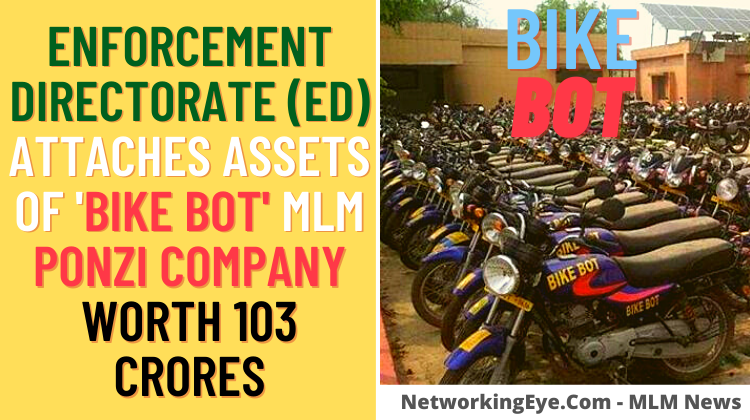
The Enforcement Directorate (ED) on Monday issued an order to attach ₹103 crores moveable and immovable assets belonging to the Noida ‘bikebot‘ Ponzi scheme.
There are 26 immovable properties with net worth ₹101.45 crores, and bank balance of ₹2.28 crore in 22 accounts. The case is being probed under the Prevention of Money Laundering Act (PMLA).
The Greater Noida-headquartered Bike Bot taxi service is accused of duping about ₹3,000- ₹4,000 crores from 2.25 lakh investors in multiple states including Uttar Pradesh, Madhya Pradesh, Rajasthan and Haryana.
ED Joint Director (Lucknow zone) Rajeshwar Singh said: “Further investigation against certain officials and beneficiaries is continuing and more attachments will be done in this case shortly,”.
The ED had booked the company that ran the alleged Ponzi scheme — Garvit innovative Promoters Ltd (GIPL) — and its promoter Sanjay Bhati and others under the PMLA in June last year after going through multiple FIRs filed against them by the Noida police.
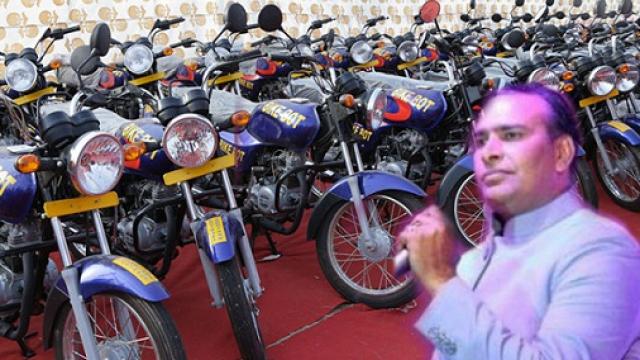
As per the ED, the company and its promoters had “floated highly lucrative investment plans in the guise of a bike taxi service in the name of ‘bike bot’ where a customer could invest in 1, 3, 5 or 7 bikes which would be maintained and operated by the company and the investor would be paid monthly rent, EMI and bonuses (in case of investment in multiple bikes) and further incentives on adding additional investors in a binary or multi-level marketing structure.”
“The company allotted franchises in various cities but the bike taxi hardly operated in these cities. The plans were floated in August 2017 and the collection of money from investors or customers and repayments to them continued till early 2019.”
“In November 2018, the company floated similar plans for e-bikes stating that the petrol bikes were facing issues regarding registration and operation,” it said.
The funds so collected have been used for repayment to the earlier investors similar to that in a ponzi scheme, the ED alleged.
It alleged that the promoters indulged in acquisition of other companies, purchase of a resort in Kullu (Himachal Pradesh) for creation of various immovable and movable assets in the name of various companies and also transferred funds to various other companies and individuals as loans and investments without proper documentation.
The agency had also recorded statements of Sanjay Bhati and others who were arrested in the case.
It had conducted raids in this case in February and surveyed a co-operative bank in Noida which “revealed several suspicious transactions and the role of the banking officials in aiding and abetting the accused in the laundering of the public money.”
At least 19 immovable properties located in Gautam Buddh Nagar, Ghaziabad, Bulandshahar, Kanpur and Indore in the name of the company have been identified by the agency.
“Seven other properties in the name of third parties have also been ascertained and verified,” the ED said.
These are great signs for Indian Direct Selling companies, and we are now hopeful that India will find a place in top 5 direct selling markets much earlier than the previous estimates of a decade
India has moved to the 15th spot in the global direct selling markets for the year 2019, up from 19th position a year before as per the WFDSA Global Statistics 2019 released recently. The information was shared by Indian Direct Selling Association’s (IDSA)Chairperson Rini Sanyal while opening a symposium organised by IDSA on the need of introducing modern concepts of businesslike Direct Selling as part of academic curriculum.
World Federation of Direct Selling Associations (WFDSA) headquartered in Washington DC (USA), is the apex international body having representation from over 60 direct selling associations from around the world. As per the 2019 global statistical data, India is ranked 6th in terms of number of direct sellers.
“Amidst Covid-19 crisis across the world, this is a strong reason to cheer as the country has registered an impressive double-digit growth last year. India has recorded highest year on year growth rate of 12.1% and the highest CAGR of 16.3% over the period of last three years, amongst the top 20 direct selling markets across the globe. These are great signs for Indian Direct Selling sector, and we are now hopeful that India will find a place in top 5 direct selling markets much earlier than the previous estimates of a decade” said Rini Sanyal.
The symposium was jointly organised by IDSA and Shoolini University, highlighting the need of updating the academic scope at graduation and post-graduation levels to include emerging business models such us Direct Selling in the curriculum.
While delivering the keynote address at the symposium, Prof. R. Hariharan, Adviser – Policy and Academic Planning Bureau, AICTE emphasised that “The good aspects of Direct Selling should reach the common man to have a win-win situation. It can be a specialised field in Management Education. Direct Selling is going to play an important role in the future”
The symposium was also addressed by Sh. Hem Pande, former Secretary of Consumer Affairs; Prof. Bejon Misra, Advisor to Govt. of Odisha and Hon. Prof. – National Law University Odisha (NLUO) and several academicians from leading universities who also voiced their opinion on the academic perspective of Direct Selling.
Finally, the old consumer protection act of 1986 got replaced with the new Consumer Protection Act of 2019 to Protect Online Customers.
The new law retains all the components of the landmark 1986 law that gave Indian consumers, their six basic rights and a consumer justice system. However, it further expands the scope of the consumer courts to deal with complaints pertaining to e-commerce, MLM/direct selling entities and unfair contracts. It also provides for product liability action against manufacturers, sellers and service providers for any defects or deficiencies or even failure to provide adequate warning about the use of the product or service.
The new law is in tune with the modern-day concepts of consumer protection, the new market dynamics and the rapid advances in digital technology that has so transformed our world. In fact, the comprehensive E-commerce Rules notified under the new law to protect consumers from unfair trade practices in the digital world encompasses all models of e-commerce and all kinds of unfair trade practices.
But what makes this law so different and comprehensive is the fact that under the new law, the government takes full responsibility for the protection, promotion and enforcement of consumer rights, through the creation of the regulatory body- the Central Consumer Protection Authority (CCPA). Even though the 1986 law encapsulated the rights of consumers, it failed to provide a regulator to enforce all 0the rights, particularly the right to be protected from unsafe goods and services and unfair trade practices, believing that the consumer court or the adjudicatory body, would somehow play the role of the regulator too. This was a major lacuna in the law.
This has finally changed. The CCPA has the power to investigate into unsafe goods, order their recall and direct refund of the cost of such goods to the consumers; it can put stop to all unfair trade practices, including unfair terms in consumer contracts and false and misleading advertisements. It can also hold celebrity endorsers liable for false and misleading promotions. It can also take to task, those selling and manufacturing adulterated and spurious goods. And the punishment prescribed under the law for some of these offences is stringent. However, it may take some time for the Authority to become fully functional.
But the consumer courts have already moved over to the new law. While the old cases will continue to be adjudicated under the old law, the new ones will have to be filed under the CP Act of 2019, which means that consumers have to keep in mind the changed pecuniary jurisdiction of these Commissions.
The consumer court at the district level or the District Consumer Disputes Redressal Commission has the jurisdiction to entertain complaints up to the value of Rs 1 crore. Those above Rs 1 crore and up to Rs 10 crore will be handled by the State Commission and complaints above Rs 10 crore will go the National Commission
However, the biggest advantage to the consumer under the new law is that
(a) you can file the complaint online, sitting in the comfort of your home and
b) the choice of the court no more depends on where the opposite party resides or has an office. You can choose a consumer court close to your home or place of work.
However, there is no substantial change in the procedure before these courts –so the lawyers will be there and so also the adjournments unless the government finds ways and means of strictly enforcing the 90-day limit for completing the adjudication, as prescribed under the old and now the new law. However, if you do not want a long flight, you can opt for mediation for quick settlement of your dispute.
Thus while the consumer protection act of 1986 laid the foundation for consumer protection in the country, the 2019 Act builds on it, brick by brick. On its strict enforcement rests consumer empowerment.
Owing to the ongoing Covid-19 pandemic and the government-mandated lockdown, the ever-improving telecom infrastructure in Himachal Pradesh has had a positive impact on the growth of the Direct Selling industry in the state.
Mr Vivek Katoch, Director, Corporate Affairs-Asia of Swedish company Oriflame in India, said “Himachal Pradesh has already achieved near hundred per cent electricity coverage. The fact that the state government is now working proactively on connecting remote places in Lahaul Spiti, Kinnaur and Chamba districts with high-speed internet connectivity which has increased the prospects of the state emerging as an attractive market for the Direct Selling industry in India.”
India Direct Selling Association (IDSA) is of the view that an increase in adoption of digital means of conducting business activities duly supported by the other industry-friendly initiatives taken by the state government, the Direct Selling industry in the state has a bright future, Mr Katoch, who also holds as Treasurer of IDSA, said.
He said people associated with Direct Selling industry were worried about the growth of their business, however, due to a robust telecom infrastructure in place in the state, direct sellers were able to swiftly adopt digital means to increase their reach and business prospects.
It is worth mentioning that Himachal Pradesh is one of the 13 states in India to have notified the Direct Selling Guidelines based on the model set notified by the Department of Consumer Affairs of the central government thereby paving way for the development of the industry in the state as well in the country.
As per the Annual Survey 2018-19 for Direct Selling industry in India, Himachal Pradesh generated a total direct selling sale of Rs 23 crore, a figure which is expected to grow robustly since the notification of Direct Selling guidelines in the state in July 2019.
Apart from providing an opportunity to generate sustainable self-income, Direct Selling industry is also promoting the growth of MSME sector in the state. “Himachal Pradesh has traditionally been a major supplier of medicinal herbs and plants. As a significant number of Direct Selling companies are engaged in the manufacture and distribution of Ayurvedic products, the state has become an attractive manufacturing hub for the Direct Selling industry,” Mr Katoch said.
The Union Government is all set to bring MLM rules under the purview of Consumer Protection Act 2019 that will further strengthen the Direct Selling industry in the country as India is one of the fastest-growing markets around the world for the business of Direct Selling. The future of Direct Selling in India is promising and states like Himachal Pradesh are poised to play a significant role in it, he added.
June 8 was an important date for many entrepreneurs because that was the day when the Department of Financial Services issued the new notification with the comments from stakeholders about the decriminalization of several laws and provisions as a result of which many people became interested in it, especially the ones working in the legal or business spheres.
Although most people became interested in the specific act: Negotiable Instruments Act and the decriminalization of the offence of cheque bounce. One more important change mentioned in the notification is the possibility of decriminalization of the schemes of money circulation that can be punished under Sections 4 and 5 of the Prize Chits and Money Circulation Schemes (Banning) Act, 1978 so it leads to the serious step further in the development of the MLM sphere.
It is not difficult for human beings who have some basic knowledge to see the MLM scheme at the first onset. Maybe you know a person who is always very excited about the «Rich Dad Poor Dad» book and suggests it to you all the time, or maybe a person who used to be your classmate suddenly asks you to come for a meeting in a hotel or a special centre and promises that the information that will be given to you will make you understand everything about successful business, or your relative phones you all the time trying to explain that you can spend your money to earn a huge amount of money.
It is obvious that there are people who earned a lot using MLM schemes, but also there are many people who couldn’t earn anything, many of them even lost their money and became really upset. However, even if it is impossible to prove statistically, most people decided not to work with these schemes.
Such MLM pitches can get you into several situations: you can be connected with MLM, or you can be arranged into the direct selling process, or you may be involved in a pyramid scheme. It is proved that a pyramid scheme is a fraud because those who offer you getting in it say that you will only need to pay a little bit for your membership and then say that you will bring your invested money back and earn a lot after recruiting other members who will recruit new members, and so on.
Every big country has strict laws regarding the necessity of punishment for these pyramid schemes. However, it is extremely hard to distinguish where is the standard MLM company and where is a pyramid scheme.
MLM and pyramid schemes.
The Prize Chits and Money Circulation Schemes (Banning) Act was created in 1978 in India, so MLM companies in this country have been struggling with the hard end of the law. The law uses a very wide definition of money circulation schemes and it explains them as schemes because of which a person receives money from a new member of the scheme and says he will pay this new member money if he can recruit other members, no matter if the money paid can come from the membership money of these new members or not.
It is obvious that advertising or creating the scheme of such a type is illegal but besides, it is also illegal to be a member of this scheme. If a person offences this law, he may be incarcerated for 3 years.
Such companies are not similar to pyramid schemes because in MLM companies all members can generate profits for themselves and for the members staying in the levels above by selling products, instead of recruiting new members like in pyramid schemes.
The necessity of easy finding which is MLM and which is a pyramid scheme; the possible necessity of having a new law.
Sellers that provide goods from their companies to consumers outside of a retail environment, for example, a store, or a special marketplace can be called «direct sellers». For selling anything they contact customers person-to-person and they will definitely need to find some distributors to develop the business. It is impossible to criminalize the fact of recruiting new members nowadays. The proposal regarding decriminalization was created to develop businesses that suffered a lot because of the slowdown caused by Covid-19 and quarantine.
The only thing that could be more effective for the development of direct selling and MLM than decriminalization is if the act can have modification with the guide to distinguish genuine companies using MLM and pyramid schemes that use people illegally.
The Prize Chits and Money Circulation Schemes (Banning) Act was signed about 40 years ago. During previous decades, India was developing in the corporate law sphere and securities regulations extremely fast which now have useful tools and methods to detect and stop pyramid schemes.
The Standing Committee on Finance of the Lok Sabha created the 21st report in September 2015 where it recommended 2 main steps to support direct sellers and MLM.
The first step is making the official registration required for all direct selling processes facilitated through the main regulatory body.
The second step is creating an understandable definition of direct selling which will help to distinguish it from any pyramid scheme.
Based on that report, the government made the Direct Selling Guidelines 2016 with the definitions of direct selling and pyramid schemes. However, these definitions are circular because the direct selling companies rely upon such companies working without using a pyramid scheme, while the pyramid schemes rely upon the scheme which is not connected with a direct selling company. Besides, these definitions lead to the confrontation with the Prize Chits and Money Circulation Schemes (Banning) Act.
The act, in general, doesn’t allow to get any benefit or income for recruiting new members, while that new guideline allows such benefits if they were caused by selling goods.
Simple decriminalization will lead to the fact that people will be vulnerable to pyramid schemes.
Besides, it can worsen the trust deficit situation for people working in this sphere, because they won’t be able to understand what is a direct seller, what is MLM, and what is a pyramid scheme. It is possible to implement all recommendations created by the Standing Committee on Finance and solve the conflict between the Act and the guidelines by creating a new law and elimination of 1978 Act, along with an accreditation system of these schemes, as a result of which businesses will finally develop again and the public interests will be protected as well.